
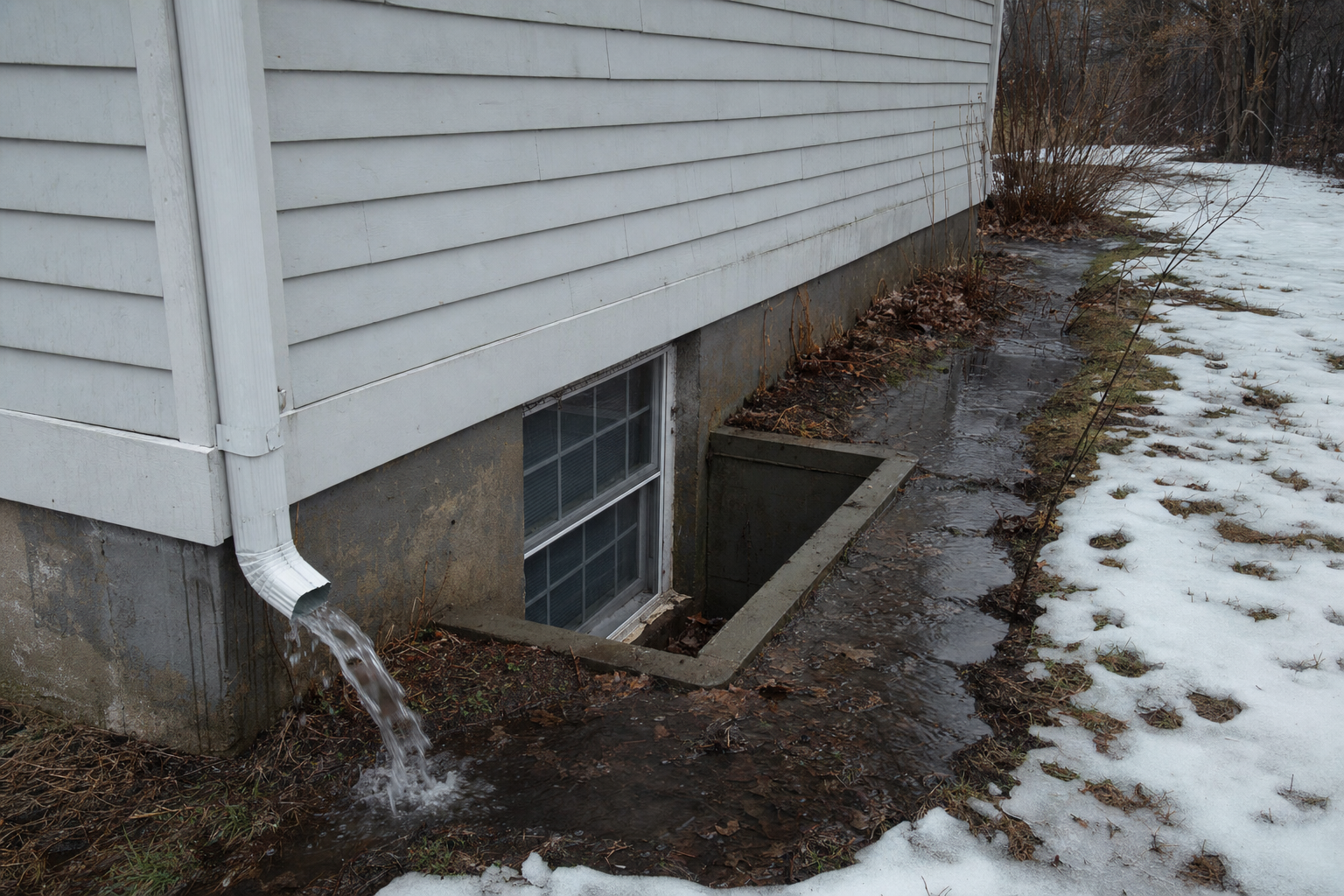
March and April push more water at Connecticut foundations than any other stretch of the year. The ground is still frozen six to eighteen inches down, snow piles are melting at the surface, and there is nowhere for that water to go but sideways into your home. We get more frantic phone calls in the first two weeks of April than in any other fortnight on the calendar.
This guide walks through what to check now, what is normal, and what is worth a free inspection before the next big melt.
Why Connecticut takes the worst of the thaw
Connecticut sits in a freeze-thaw belt that runs through most of southern New England. The CT IRC sets a 42-inch frost depth for footings, which tells you how deep winter can actually push into our soil column. Hartford County and Litchfield County typically run ten to twenty days of subfreezing temperatures in a normal January, and the snow pack accumulated over those weeks does not disappear gradually. It releases in two or three concentrated melt events between mid-March and mid-April.
The Connecticut River floodplain, the Naugatuck Valley, and the lowland sections of Fairfield County are particularly exposed because they sit at the bottom of regional drainage. Snowmelt from higher elevations adds to local groundwater in a way that pushes basement water tables up by two to four feet during the worst weeks.
What actually happens during the thaw
The top inch of soil thaws first. Below that, the frost line can stay locked until late April depending on how cold January and February ran. Meltwater hits the thawed surface layer and runs along the top of the frost line until it finds a path of less resistance, which is often the disturbed soil right next to your foundation.
That is why basement seepage during snowmelt is not a sign your foundation has suddenly failed. It is a sign that the perimeter drainage cannot keep up with a temporary, predictable surge.
Five things to check this week
- Gutter discharge points. Downspouts should release water at least four feet from the foundation, ideally onto a graded surface that carries it further. If yours dumps right at the wall, you are funneling roof runoff straight into the soil column next to your basement.
- Window wells. Clear leaf litter, ice dams at the bottom, and any standing water now. A window well that fills with meltwater becomes a swimming pool against the glass, and basement window seals were not designed for hydrostatic pressure.
- Grading within six feet of the foundation. Look for low spots, settled fill, or places where the lawn now slopes toward the house instead of away. Even a slight reverse slope concentrates meltwater at the wall.
- Sump pump. Pour a five-gallon bucket of water into the basin. The pump should kick on within a few seconds and clear it inside thirty seconds. If it hesitates, runs dry, or short-cycles, you have a problem worth fixing before the next thaw.
- Basement walls and floor cove joint. A flashlight along the wall-to-floor seam will show any active seepage as a damp shadow or efflorescence ring. Photograph anything you find.
A week-by-week timeline for the thaw season
Last week of February
Take a baseline walk of the basement before the melt starts. Photograph each wall, each crack, and the cove joint at four corners. These photos become your reference if seepage appears in March.
First week of March
Clear ice dams from window wells. Confirm sump pump operation with a bucket test. Check that the discharge line is not frozen at the wall exit. A frozen discharge line is the single most common cause of catastrophic basement flooding during the thaw.
Mid-March through mid-April
Walk the basement every three or four days during active melt. Photograph anything new. Compare to the February baseline. Call us at the first sign of standing water or new efflorescence; the longer water sits, the more damage it does.
Common myths about snowmelt seepage
- “It only happened once, so it must be fixed.” Snowmelt patterns vary year to year. A dry April does not mean the underlying drainage problem is solved. The water just did not show up that year.
- “Sealing the wall from the inside will stop it.” Hydrostatic pressure from a saturated soil column will push water through any interior coating within a few seasons. The fix is drainage, not paint.
- “My sump pump just needs to run longer.” A sump pump running continuously for hours during a thaw event is undersized or has an undersized discharge line. Continuous duty kills motor windings within months.
- “The cracks are old, so they cannot be the source.” Old cracks are exactly where freeze-thaw expansion has been working all winter. The crack you photographed in November is wider in April.
When seepage means something bigger
A single damp spot during the heaviest thaw week of the year is not an emergency. Repeated seepage in the same spot across multiple events is the signal. So is any of the following:
- Horizontal cracks in a block or poured wall, especially with inward bowing.
- Staircase cracks following mortar joints.
- Efflorescence (white chalky residue) growing on the wall above the cove joint.
- A musty smell that lingers after the basement has dried.
Any of those put a foundation specialist on the call list, not a general handyman.
Cost ranges for typical thaw-season fixes
- Gutter and downspout corrections: $200 – $800 depending on linear footage and extension type.
- Sump pump replacement with battery backup: $1,200 – $2,800 installed, depending on basin condition and discharge run.
- Interior perimeter drainage: $9,000 – $14,000 for a typical 1,400 sq ft basement, full perimeter.
- Crack injection for non-structural vertical cracks: $400 – $900 per crack.
- Carbon fiber strap reinforcement for bowing walls: $4,500 – $7,500 for a 20-foot wall section.
Three drivers move these numbers: basement size and perimeter length, existing wall material (poured concrete is easier than block, block is easier than fieldstone), and access conditions (finished basements that need framing removed cost more).
Materials and equipment that actually matter
Not every product on the shelf is built for our climate. The ones that hold up through Connecticut winters:
- Zoeller cast-iron sump pumps for primary duty. The cast-iron housing dissipates heat better than thermoplastic, which extends motor life under heavy spring runoff.
- Battery backup units with deep-cycle marine batteries. Standard car batteries do not handle the discharge cycling of a backup pump.
- 20-mil reinforced polyethylene vapor barrier for any wall membrane application; thinner barriers tear during install.
- DMX air-gap drainage membrane for interior wall coverage; the dimpled face lets any wall seepage flow down to the perimeter drain rather than sitting against the wall.
When to call a pro vs handle it yourself
Clear DIY territory: gutter cleaning, downspout extensions, regrading low spots with topsoil, replacing window well covers, bucket-testing the sump pump.
Call a foundation specialist for: any horizontal crack, any inward bowing, recurring seepage in the same spot across multiple springs, efflorescence above the cove joint, a sump pump running more than two hours continuously during an event, or any musty smell that survives a week of ventilation.
Spring seepage in a real-estate transaction
Listing a Connecticut home between February and May? Active basement seepage during a buyer’s inspection becomes a negotiation point that costs more than the underlying repair. Buyers consistently reduce offer prices by two to three times the actual cost of waterproofing once a wet basement appears on an inspection report. The math favors fixing it before the listing photos, not after the offer.
FAQs
My basement gets a little damp every spring but it dries out by May. Do I need to fix it?
Probably yes, eventually. A basement that goes through several weeks of dampness each spring is supporting low-grade mold and material decay that you may not see. The structural cost of waiting is usually higher than the cost of solving it now. We can advise once we see it.
Can I just run a dehumidifier through April?
A dehumidifier handles air-side humidity. It does not stop water coming through the wall or up through the cove joint. If your seepage is wall-source, the dehumidifier is fighting the symptom, not the cause.
How long does interior drainage installation take during the busy season?
Three to five days of on-site work for a typical 1,400 sq ft basement. Schedule lead time in March and April runs four to six weeks because spring is our peak window. Book an inspection now if you want the work done before next winter.
Is the warranty transferable if I sell?
Yes. Our workmanship warranty on interior drainage transfers to the next owner, which is a selling point on the listing. The sump pump manufacturer warranty (typically five years) is also transferable.
What we recommend before April hits
If you have had basement seepage in two of the last three springs, do not wait for it to happen a third time. We do free inspections across Connecticut and Westchester / Dutchess counties in New York. We will tell you what is causing it, what it would cost to fix, and whether it is the kind of thing that can wait or the kind that should not.
We put the estimate in writing within 24 hours, before you commit to anything.
Book your free inspection
No obligation. Written estimate within 24 hours.
Tell us what is happening with your basement and we will email a written estimate within 24 hours. No cost, no obligation, no high-pressure follow-up.
Get my free estimate