
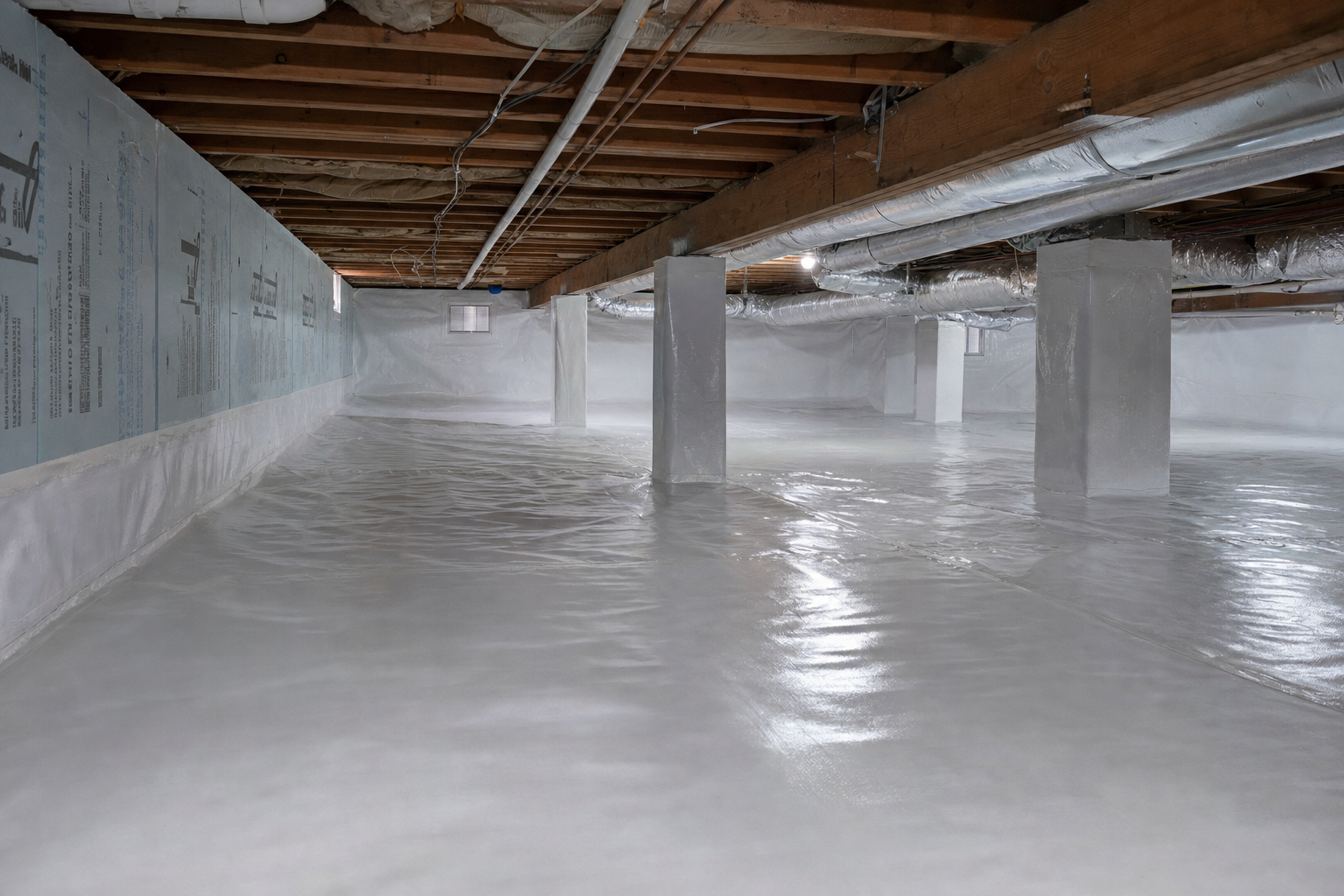
Most crawl spaces in Connecticut and New York were built to be ventilated. The thinking was that outside air moving through the space would prevent moisture buildup. Building science research over the last 25 years has shown the opposite is true: in our climate, those vents pull humid summer air into a cool crawl space, where it condenses and creates the exact moisture problem they were supposed to prevent.
Crawl space encapsulation fixes this. Here is what the work involves, what it costs, and when it is worth doing.
Why vented crawl spaces fail in our climate
Connecticut and New York summer outside dew points routinely exceed 65 degrees Fahrenheit from late June through early September. Crawl space surfaces sit at 55 to 65 degrees year-round. When 75-degree, 75% relative humidity outside air enters a crawl space and hits 60-degree surfaces, the moisture condenses out. The vents that were supposed to ventilate moisture out are actually delivering moisture in.
The result is the pattern we see in thousands of CT and NY homes: damp insulation, rusted ductwork, mold on the underside of subfloors, and a musty smell that rises through the floor into the living space above.
What encapsulation actually means
Encapsulation is the process of fully sealing a crawl space against outside air, ground moisture, and water vapor. The components are:
- Heavy-duty vapor barrier (typically 12 to 20 mil reinforced polyethylene) covering the entire floor and running up the walls.
- Sealed seams between sheets, mechanically fastened at the wall, with all overlaps taped.
- Insulation on the walls (rigid foam or closed-cell spray foam) instead of the floor above.
- Sealed vents (the existing crawl space vents get closed permanently).
- Conditioned air supply (a small HVAC register or a dedicated dehumidifier).
The end result is a clean, dry, conditioned space that is now part of the building envelope.
Why it matters in our climate
A vented crawl space in a CT or NY summer pulls in air at 75 to 85 degrees and 70 to 85% relative humidity. That air hits crawl space surfaces (joists, vapor barrier, ductwork) that are 15 to 20 degrees cooler. Condensation forms. Mold colonies establish on wood within days. Insulation gets damp and loses R-value. The smell rises into the living space through every gap in the subfloor.
Encapsulation eliminates the air source, eliminates the condensation, and typically reduces overall home humidity by 8 to 15% during summer months.
The encapsulation install: day by day
Day 1: Cleanout and prep
Remove existing damaged insulation, dispose of any rodent contamination, and clean the floor and walls. If standing water or significant mold is present, this step extends into Day 2 with remediation work.
Day 2: Drainage and vapor barrier prep
If the crawl space had standing water history, a small perimeter drain and basin pump go in first. Then the 20-mil reinforced polyethylene vapor barrier is rolled out across the floor with 12-inch seam overlaps.
Day 3: Seams, walls, mechanical fastening
All vapor barrier seams are taped with butyl seam tape. The barrier runs up the foundation walls and is mechanically fastened at the wall with a perimeter strip and tape system. This is the most labor-intensive day.
Day 4: Vent sealing, insulation, conditioning
Existing vents are permanently sealed. Wall insulation (typically 2-inch rigid foam or closed-cell spray foam) goes on the interior of the foundation walls. The rim joist is air-sealed with spray foam. A dehumidifier or HVAC supply register is set to condition the space.
Day 5: Finish and walkthrough
Final inspection, cleanup, walkthrough with the homeowner. Hygrometer placement so the homeowner can verify the conditioning is working.
Cost and timeline
A typical 1,000 to 1,500 square foot crawl space in CT or NY runs $8,000 to $18,000 for full encapsulation, depending on access, existing conditions, and whether structural repairs are needed alongside the encapsulation work.
Three drivers move the number:
- Access height. A 4-foot crawl is much easier to work in than a 24-inch crawl; the latter adds significant labor.
- Existing conditions. Standing water, mold remediation, or rodent contamination cleanup all add days.
- Dehumidification choice. Connecting to existing HVAC has the lowest material cost; a dedicated Aprilaire or SantaFe unit adds $1,400 to $2,200.
The install takes 3 to 6 days for the encapsulation itself. If the crawl space has standing water, mold remediation, or rim joist insulation needs, those add days.
Materials we specify
- 20-mil reinforced polyethylene vapor barrier. Anything thinner tears during install or under foot traffic.
- Butyl seam tape rated for 50-year service.
- 2-inch closed-cell rigid foam or 2-pound closed-cell spray foam on the walls (R-10 minimum).
- Aprilaire E100 or SantaFe Ultra series dehumidifier for dedicated conditioning. We do not recommend hardware-store portable units for crawl spaces; they fail within 3 to 5 years under continuous duty.
- Mechanical wall fasteners for the perimeter strip; adhesives alone fail within a decade.
What to ask before you sign
- Is the vapor barrier mechanically fastened to the wall or just adhered?
- What mil thickness is the vapor barrier?
- Are the existing vents being sealed or left open?
- Is the space being conditioned with HVAC supply or a dedicated dehumidifier?
- Is rim joist sealing included or extra?
- Is the warranty transferable to a future buyer?
- Is mold remediation included in the price if mold is found during cleanout?
- Will you encapsulate plumbing and electrical penetrations or leave them open?
When encapsulation is and is not worth it
Encapsulation is worth it if:
- You have musty smells in the living space.
- You have visible mold on joists or subfloor in the crawl space.
- You have elevated humidity in the rooms above the crawl space.
- You have rotting insulation, sagging insulation, or rodent damage.
- You are planning to sell within five years (CT and NY buyers’ inspections are flagging unencapsulated crawl spaces increasingly).
It is probably not worth it if:
- The crawl space is dry, clean, has no smell, and the rooms above are comfortable. A monitoring hygrometer and an annual visual check might be all you need.
Common myths
- “Vents prevent moisture problems.” Modern building science contradicts this. In CT and NY climate, vents make crawl space moisture worse, not better.
- “Encapsulation traps moisture.” Only if it is done wrong. A properly encapsulated, conditioned crawl space stays drier than any vented space.
- “A thicker vapor barrier is overkill.” 20-mil is the working spec; 6-mil contractor plastic tears, develops pinhole leaks, and fails within 5 to 10 years.
- “I can just put plastic down myself.” Loose plastic without seam tape, wall fastening, and proper conditioning is worse than no plastic at all because it creates a stagnant air pocket.
Warranty terms
- Workmanship: Lifetime transferable.
- Vapor barrier: Manufacturer warranty, typically 25 years for 20-mil reinforced poly.
- Dehumidifier: Manufacturer warranty, typically 5 years for Aprilaire and SantaFe.
- Insulation: Manufacturer warranty per material.
FAQs
Will encapsulation reduce my heating and cooling bills?
Yes, typically 8 to 18% on annual HVAC costs in CT and NY homes with previously vented crawl spaces. The savings come from no longer trying to condition outside air entering through the floor.
Does encapsulation interfere with radon mitigation?
It can complement it. Sealed-vapor-barrier crawl spaces work well with sub-membrane depressurization radon systems. Coordinate the two installs if both are needed.
Will my home pass a real-estate inspection after encapsulation?
Yes, and increasingly buyer’s inspectors are flagging unencapsulated crawl spaces as deferred maintenance. An encapsulated crawl with a transferable warranty becomes a positive on the listing.
What if the crawl space currently has water?
Water source has to be addressed first. Encapsulation over an active water source seals the moisture in, which is worse than the original condition. Most water-source projects include perimeter drainage and a basin pump as part of the encapsulation scope.
Free inspection
If you are not sure which side of that line you are on, we will tell you honestly. The inspection is free, the estimate is in writing within 24 hours, and we do not pressure homeowners into work they do not need.
Book your free inspection
No obligation. Written estimate within 24 hours.
Tell us what is happening with your basement and we will email a written estimate within 24 hours. No cost, no obligation, no high-pressure follow-up.
Get my free estimate