
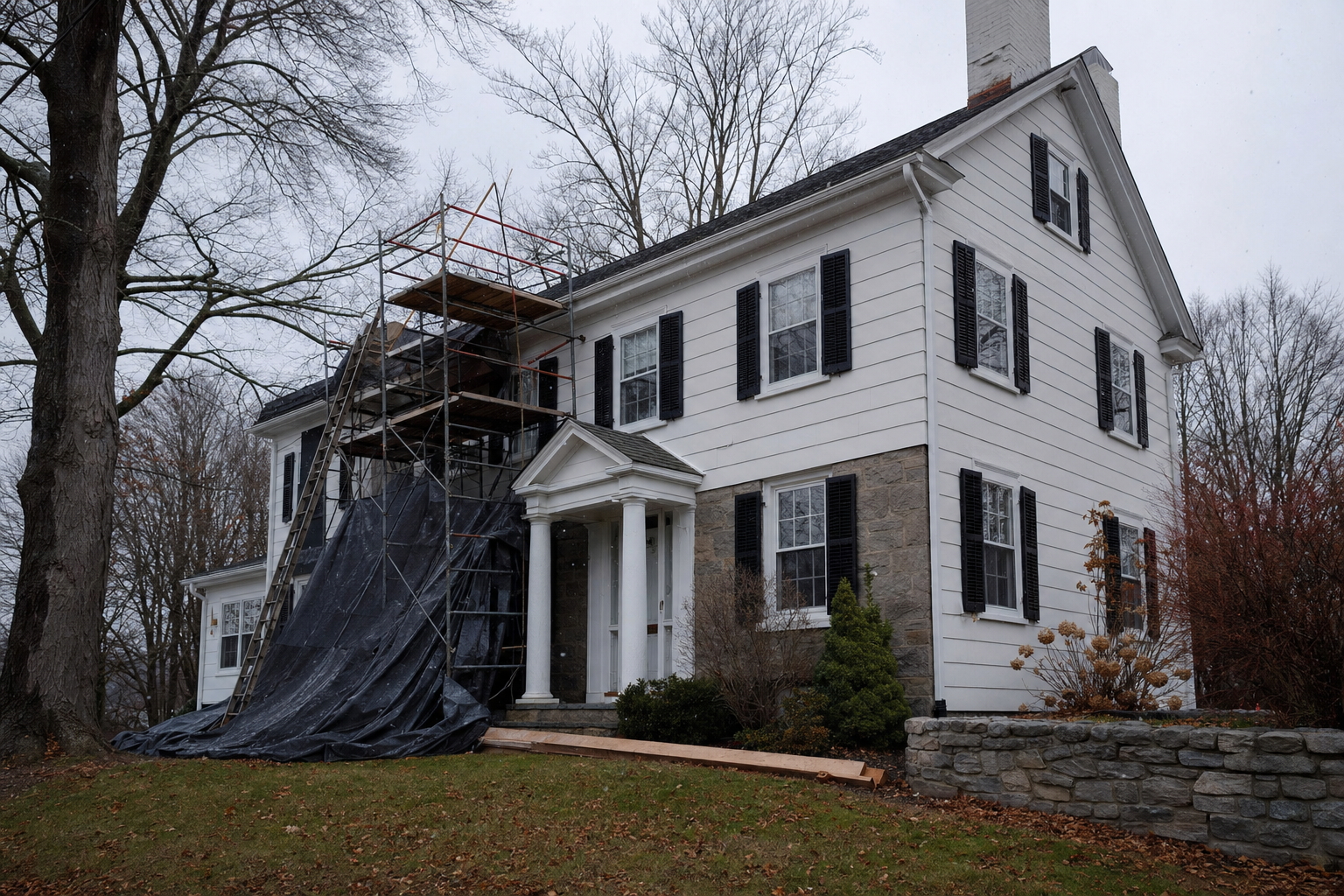
Poughkeepsie’s historic Arlington neighborhood has a specific housing stock with a specific set of basement issues. Most of the homes are colonials built between 1895 and 1935, with fieldstone or early concrete block foundations, on properties that often slope down toward the Hudson or toward Vassar Brook. The combination of older foundations, sloped grading, and a regional water table that fluctuates significantly between seasons creates a pattern of recurring basement problems we see frequently.
Here is what we see most often in these homes.
Why Arlington has the patterns it does
Arlington was built out as a streetcar suburb adjacent to Vassar College between 1895 and 1935. The housing stock reflects that era exactly: balloon-frame Colonial Revivals, Foursquares, and Dutch Colonials on lots that follow the natural topography (the older lots are not graded flat). The soil profile is regional Hudson Valley clay over glacial deposits, with shallow water table behavior driven by Vassar Brook and Wappinger Creek seasonal flow.
NY Residential Code R301.2 sets a 42-inch frost depth for footings throughout Dutchess County. Pre-code foundations from before the 1940s may not reach that depth in all areas, which compounds the seepage issues.
Fieldstone foundation seepage at floor-to-wall joints
The stone walls themselves often hold up well. Where they fail is at the cove joint, where the wall meets the slab. Original construction in this era rarely included any waterproofing membrane at the joint, and over 100 years of seasonal moisture cycling has loosened the original mortar.
The interior drainage approach (perimeter trench, gravel bed, perforated pipe, vapor barrier, sump pump) is the standard solution. Exterior excavation on a sloped Arlington lot is usually not practical because of access constraints and tree root systems.
Slope-driven hydrostatic pressure
Many Arlington lots slope toward the home rather than away from it, or have grades that have settled over time toward the foundation. During wet seasons, surface and subsurface water collects against the uphill wall and creates ongoing hydrostatic pressure.
The symptoms:
- Seepage that always shows up on the same uphill wall, never the downhill wall.
- Worse seepage during multi-day rain events than during single heavy storms.
- Efflorescence concentrated on one side of the basement only.
- Seasonal pattern (peak during March to May spring saturation).
The right fix often combines exterior grading correction (regrading the affected slope away from the home) with interior drainage as a backup.
Coal chute and old bulkhead leaks
Most Arlington colonials were built with coal heating. Coal chutes and original bulkheads are still common, often abandoned in place after the heating system was converted. These are persistent water entry points that get overlooked because they are not part of the active basement.
Common situations: coal chute door rotted out and replaced with plywood (not flashed, leaks during rain), bulkhead with failed gasket seal (water enters at every door cycle), original chute opening masonry-infilled poorly (cracks at the joint let water in).
Lowest-cost fix: permanent masonry infill with proper flashing, $400 to $900 per opening. Mid-tier: new code-compliant bulkhead with flashing and drainage, $4,500 to $9,000.
Old block foundations from 1925 to 1945
A subset of Arlington homes have early concrete block foundations from the late 1920s through World War II. The blocks from this era are smaller than modern blocks (typically 6 inch wide rather than 8 or 10), and the mortar joints have aged unevenly. Bowing is more common in these walls than in older fieldstone or newer post-1950 block.
For bowing under 2 inches: carbon fiber strap reinforcement. For bowing 2 to 4 inches: steel beam bracing. For bowing over 4 inches with sill plate displacement: exterior excavation and partial wall replacement.
Sloped sites and discharge planning
On a sloped Arlington lot, sump pump discharge planning matters more than usual. If the discharge exits on the uphill side, you are pumping water back into the same soil column that just filled the basin. Discharge must go to the downhill side or to a properly sized dry well.
Dry well sizing: a 4-foot diameter by 4-foot deep dry well filled with clean stone handles typical residential discharge. For higher volume, two wells in series or a larger single well may be required. Verify local code requirements; some Dutchess County jurisdictions restrict discharge proximity to property lines and waterways.
Cost ranges for Arlington-area work
- Interior drainage (1,400 sq ft fieldstone basement): $10,000 – $16,000.
- Grading correction (regrade up to 30 linear feet): $1,500 – $4,500.
- Sump pump with battery backup and dry well discharge: $2,800 – $4,200.
- Coal chute permanent closure: $400 – $900.
- Carbon fiber strap reinforcement (20-foot wall): $4,500 – $7,500.
- Bulkhead replacement: $4,500 – $9,000.
Common myths in the Arlington market
- “My basement has always been damp, it is just an old house thing.” Damp is the precondition for mold and progressive deterioration. The house surviving 100 years does not mean the basement is fine; it means the symptoms have not become emergencies yet.
- “Exterior excavation is the only real fix.” On a sloped Arlington lot with mature trees and tight access, interior drainage is the durable solution.
- “My sump pump is fine because it kicks on.” A pump that kicks on and barely keeps up during a heavy event is undersized. Sizing matters as much as functioning.
- “Coal chutes are not a real water source.” They are. Many are responsible for a majority of a basement’s seepage volume despite looking innocuous.
Timeline of typical work
- Inspection: 60 to 90 minutes on site.
- Estimate: Within 24 hours, in writing.
- Project start: 3 to 6 weeks during peak (spring), 1 to 3 weeks off-peak.
- Interior drainage install: 3 to 5 days.
- Grading correction: 1 to 2 days (separate from interior work).
- Walkthrough and final payment: Day of completion.
What to ask
If you own an Arlington colonial and are considering basement work:
- Is the proposed drainage independent of the local site drainage?
- Where will the sump pump discharge exit?
- Is the historic district status going to affect any exterior work?
- Is the contractor familiar with fieldstone foundation repointing?
- Is the warranty transferable to a future buyer?
- Are coal chute and bulkhead penetrations included in the scope or extra?
FAQs
Is my Arlington home in a flood zone?
Properties along Vassar Brook and lower Wappinger Creek areas may be within the FEMA 100-year floodplain. Check the FEMA flood map service for your specific address. Flood zone status affects discharge planning and may require backflow preventers.
Will historic district review apply?
Parts of Arlington are within the Vassar Old Campus and Arlington historic districts. Interior work typically does not trigger review; exterior excavation, regrading, or bulkhead replacement may. Verify with the City of Poughkeepsie before exterior work.
Can I finish the basement after the work?
Yes, with appropriate moisture management. We recommend a dimpled subfloor (DRIcore or equivalent) under any finished flooring, a 1-inch furring gap from the wall, and either an HVAC supply register or a dedicated dehumidifier in the finished space.
Is the warranty transferable when I sell?
Yes. Lifetime transferable workmanship warranty on interior drainage, carbon fiber straps, and crack injection. The transferable warranty becomes a documented selling point on the listing.
Free inspection
We work across Dutchess County including Arlington and the surrounding Poughkeepsie neighborhoods. Free inspection, written estimate within 24 hours, no pressure to sign on the visit.
Book your free inspection
No obligation. Written estimate within 24 hours.
Tell us what is happening with your basement and we will email a written estimate within 24 hours. No cost, no obligation, no high-pressure follow-up.
Get my free estimate