
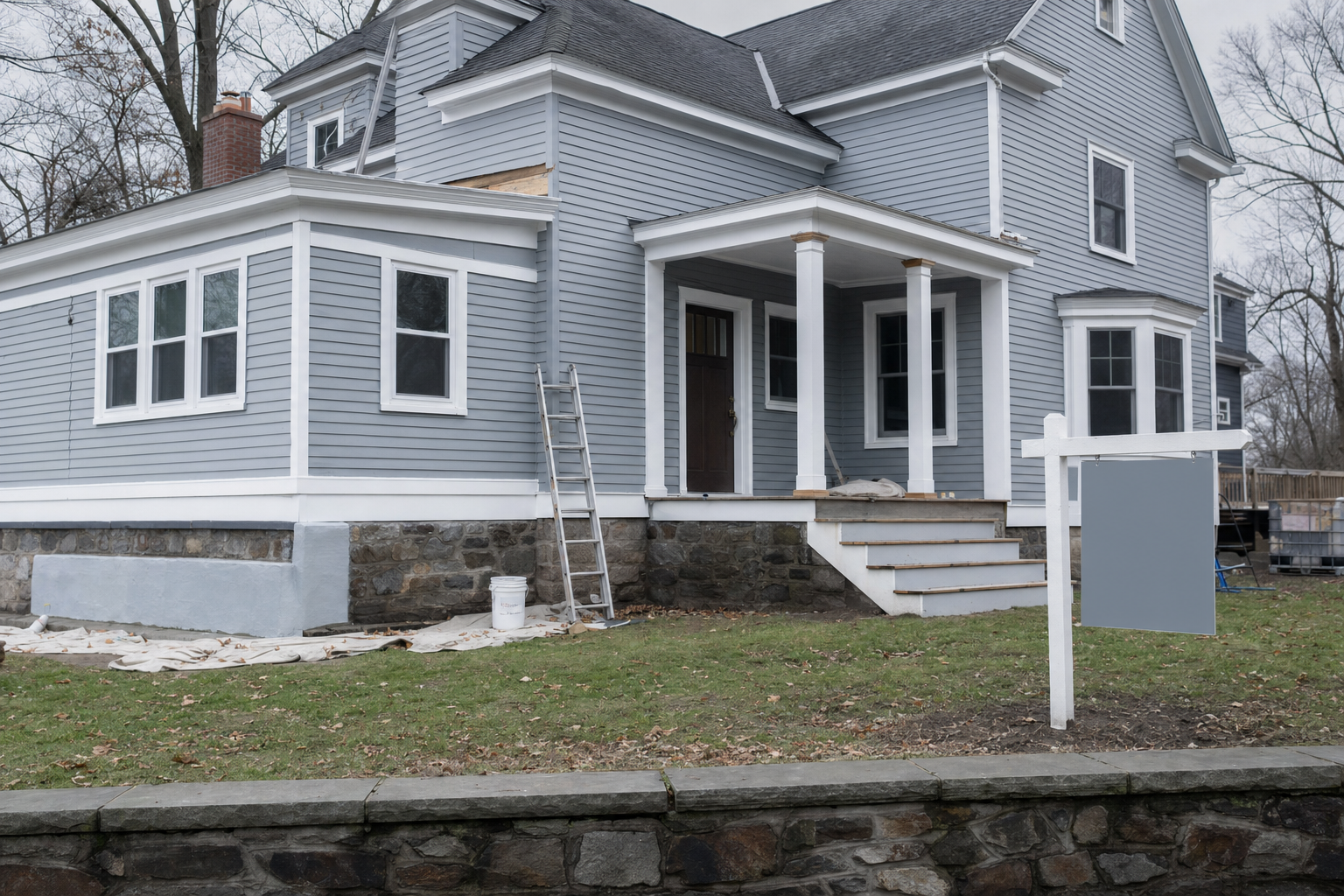
You are 60 to 90 days from listing. The basement walls show some cracking. You can either fix it now and list with documentation, or list as-is and let the buyer’s inspector raise it as a negotiating point. The math almost always favors fixing it first, but only if you understand what counts as “fixed” in the eyes of an appraiser, a lender, and a buyer’s attorney.
Here is what foundation repair before listing actually looks like across CT and NY, what it costs, and what paperwork the next buyer’s team will accept.
Why fixing first usually wins
Three structural realities of CT and NY home sales push the math toward pre-list repair:
- Buyers anchor on the worst-case repair cost. When an inspector flags a foundation crack, the buyer’s mental number is rarely the contractor’s actual number. We see $4,500 repairs negotiated as $15,000 credits routinely.
- Lenders increasingly require remediation, not credits. FHA and VA loans almost always require documented repair before close. Conventional loans now often follow suit when appraisers note “structural condition.”
- Deal velocity matters in a closing market. An unfixed foundation issue creates a 7 to 14 day re-negotiation window that some buyers will not wait through.
Triage: which foundation findings actually need pre-list repair
Not every crack needs $12,000 of carbon fiber. Triage your basement findings into three buckets:
Bucket 1: Fix before listing
- Horizontal cracking in CMU block walls with any measurable bowing (more than 1/2″ of inward deflection).
- Step cracking that extends through more than 4 courses of block.
- Active water seepage at any visible crack.
- Wet floors during inspection week (if you can avoid showing it wet, do).
- Settled corners with visible vertical separation of the wall from itself.
- Bowing of more than 1″ total wall deflection from plumb.
- Stair-step cracking in stone or rubble foundations with visible water staining.
Bucket 2: Document and disclose, do not necessarily repair
- Hairline vertical cracking in poured walls under 1/16″ wide with no offset.
- Cosmetic spalling on exposed concrete with no water history.
- Tight, dry hairline shrinkage cracking, especially within 5 feet of corners.
- Minor parging deterioration on stone walls with no active seepage.
Bucket 3: Engage a structural engineer before deciding
- Wall bowing of more than 2 inches.
- Diagonal cracking near beam pockets or column locations.
- Settlement cracking on multiple sides of the home at once.
- Any history of structural movement above grade (sticking doors, cracking drywall over windows, sloping floors upstairs).
An engineer’s stamped report carries weight with buyer’s lenders and appraisers; a contractor’s repair report is supporting documentation, not a substitute for engineering on structural questions.
Common foundation problems in CT and NY housing stock
- Pre-1945 stone or rubble foundations (common in Hartford’s West End, Asylum Hill, Frog Hollow; Poughkeepsie’s Mansion Square; Yonkers’ Park Hill): mortar joint deterioration is the dominant failure mode. Repair via repointing and interior dimpled-membrane drainage.
- 1945 to 1970 CMU block (West Hartford, postwar Fairfield, White Plains, Carmel): bowing from soil pressure and cove-joint seepage. Repair via carbon fiber straps for moderate bowing; wall anchors for severe bowing.
- Post-1970 poured concrete (most suburban CT and NY): hairline shrinkage cracking, occasional cove-joint cracking. Repair via polyurethane or epoxy injection.
- Clay-belt foundations (Hudson Valley around Poughkeepsie; Hartford floodplain; parts of Fairfield County): lateral pressure swings between wet and dry seasons cause cyclic stress on walls.
Repair playbook by condition
Vertical and diagonal cracks in poured walls
Polyurethane or epoxy injection from inside, typically $400 to $900 per crack. Carries a long-term warranty when done by a licensed contractor. The injection fills the crack from outside face to inside face, structurally restoring the wall. Closes water path permanently if applied correctly.
Bowing block walls
Carbon fiber straps (Grip-Tite, Fortress, or equivalent) bonded to the wall with structural epoxy. $550 to $850 per strap, typical job needs 4 to 10 straps. Lifetime transferable warranty. Stops further inward movement; does not push the wall back. For walls that have moved more than 2 inches, helical wall anchors or steel I-beam shoring may be required.
Settled foundations
Helical piers or push piers driven to load-bearing strata. $1,800 to $3,500 per pier; typical settlement repair needs 4 to 12 piers. Carries a lifetime transferable warranty when installed by certified contractors. Best for additions, settled corners, or chronic settlement on clay soils.
Stone foundation seepage
Repointing of failed joints, parging where needed, interior drainage with DMX dimpled membrane and a perimeter drain to a sump. $7,500 to $18,000 for a full basement perimeter on a typical 1,200 sq ft footprint.
What the appraiser, lender, and buyer’s attorney want to see
- Engineer’s report (if any structural concern). Stamped, dated, signed.
- Contractor’s scope of work: signed estimate, work description with materials and quantities.
- Completed work invoice: line items match the scope, with date of completion.
- Permit documentation where required (towns vary on whether crack injection or carbon fiber requires permit; structural repairs and underpinning always do).
- Transferable warranty paperwork: assignable to the next owner, with terms and exclusions clearly stated.
- Photographs: before, during, after.
Keep all of this in a “house papers” folder. Hand it to the listing agent and the buyer’s attorney at the first request.
Cost ranges to plan for (2024 CT and NY pricing)
- Crack injection (per crack): $400 to $900.
- Carbon fiber strap install: $550 to $850 per strap.
- Wall anchor system: $7,500 to $18,000 per wall.
- Helical or push pier underpinning: $1,800 to $3,500 per pier; project total typically $9,000 to $35,000.
- Stone wall repointing: $40 to $90 per linear foot.
- Interior perimeter drainage: $5,500 to $14,000.
- Sump pump (contractor-grade): $1,400 to $3,200.
- Engineer’s evaluation and stamped report: $700 to $1,800.
Three drivers move you within these ranges: severity of the condition, accessibility (basement clutter, finished walls, low ceilings), and whether work has to be coordinated with related repairs like waterproofing or finishing.
Common mistakes sellers make
- Patching with hydraulic cement and calling it “repaired.” Visible patch work telegraphs “history of water” to every inspector and buyer who walks the basement.
- Painting walls white before listing. Fresh paint over cracks reads as concealment in most home inspection reports. Inspectors are trained to look for it.
- Skipping the permit on a structural repair. A buyer’s attorney who pulls town records and finds no permit for a $15,000 repair has a negotiation lever.
- Hiring the lowest bidder on a structural job. Wall anchors and piers carry lifetime warranties only from the original installer; if the installer is no longer in business, the warranty is worthless to the next owner.
- Disclosing too vaguely or not at all. CT and NY both require honest disclosure of known issues. “Some water in basement during heavy rain” with documented repair is defensible; concealment is not.
- Treating cosmetic spalling like a structural issue. Spending $8,000 on a wall that needed $400 of cosmetic patching is its own form of error.
Materials and systems that hold up in resale
- Grip-Tite or ECP carbon fiber straps for moderate bowing.
- Helical piers (manufacturer-stamped, ICC-ES report on file) for settlement.
- Polyurethane crack injection (urethane stays flexible, accommodating minor future movement).
- DMX 1-Step or equivalent dimpled drainage membrane behind any new parging.
- Zoeller M53 or M98 primary sump with battery backup.
- 20-mil reinforced vapor barrier on slab in unfinished sections.
Timeline of a typical pre-list foundation repair
- Day 1: Free inspection, written estimate within 24 hours.
- Day 2 to 7: Engineer evaluation if needed, permit application if required.
- Week 2: Materials staged on site.
- Week 2 to 3: Repair work performed; typical crack injection or carbon fiber install is 1 to 3 days. Pier underpinning is 3 to 7 days.
- Week 3 to 4: Final inspection, permit close-out, warranty paperwork issued.
Plan on 3 to 6 weeks from first call to listing-ready paperwork. Engineer scheduling and permit cycles are the typical bottlenecks.
When to call a pro versus DIY
DIY makes sense for: exterior grading correction, downspout extensions, gutter cleaning, window well covers, removal of stored items from the basement perimeter. These often improve the basement’s inspection profile measurably.
DIY does not make sense for: crack injection, structural straps, piers, anchor systems, drainage installations, or anything that requires a permit. The Connecticut HIC license requirement and New York contractor licensing apply to foundation work, and an unpermitted DIY repair is worse for resale than no repair at all.
Frequently asked questions
How much does foundation repair cost on average in CT and NY?
For typical homes, the range is $4,500 to $18,000 for most non-structural repairs. Structural work involving piers or anchors runs $9,000 to $35,000. Severe cases with multiple sides involved can reach $50,000 or more.
Will the buyer notice if I repair before listing?
Probably yes. The buyer’s inspector will see fresh injection marks or carbon fiber straps. This is fine. Disclose the work, hand over the paperwork, and the inspector reads it as “repaired and documented” rather than “concealed.”
Does foundation repair affect appraised value?
Generally yes, positively. A documented repair with a transferable warranty removes a major risk factor from the appraiser’s checklist. The dollar lift depends on the appraiser and the comp pool.
How long is a foundation repair warranty good for?
Most reputable contractors offer lifetime transferable warranties on structural repairs (piers, anchors, carbon fiber). Crack injections typically carry 10-year to lifetime warranties. The transferability is what matters at resale: the next owner inherits the coverage when you provide the assignment paperwork.
Should I disclose old repairs?
Yes. Both CT and NY require disclosure of known structural issues, including repaired ones. Disclosed repairs with paperwork read as transparency; undisclosed repairs that get discovered read as concealment and can trigger post-close litigation.
Where to go next
Related reading: 5 steps when the inspector flags moisture, helical piers versus push piers, carbon fiber straps for bowing walls, and our foundation repair service overview.
If you are preparing a house for the spring or fall market, we run free inspections with a 24-hour written estimate turnaround. We will tell you what needs to be done, what can wait, and what to disclose.
Book your free inspection
No obligation. Written estimate within 24 hours.
Tell us what is happening with your basement and we will email a written estimate within 24 hours. No cost, no obligation, no high-pressure follow-up.
Get my free estimate