
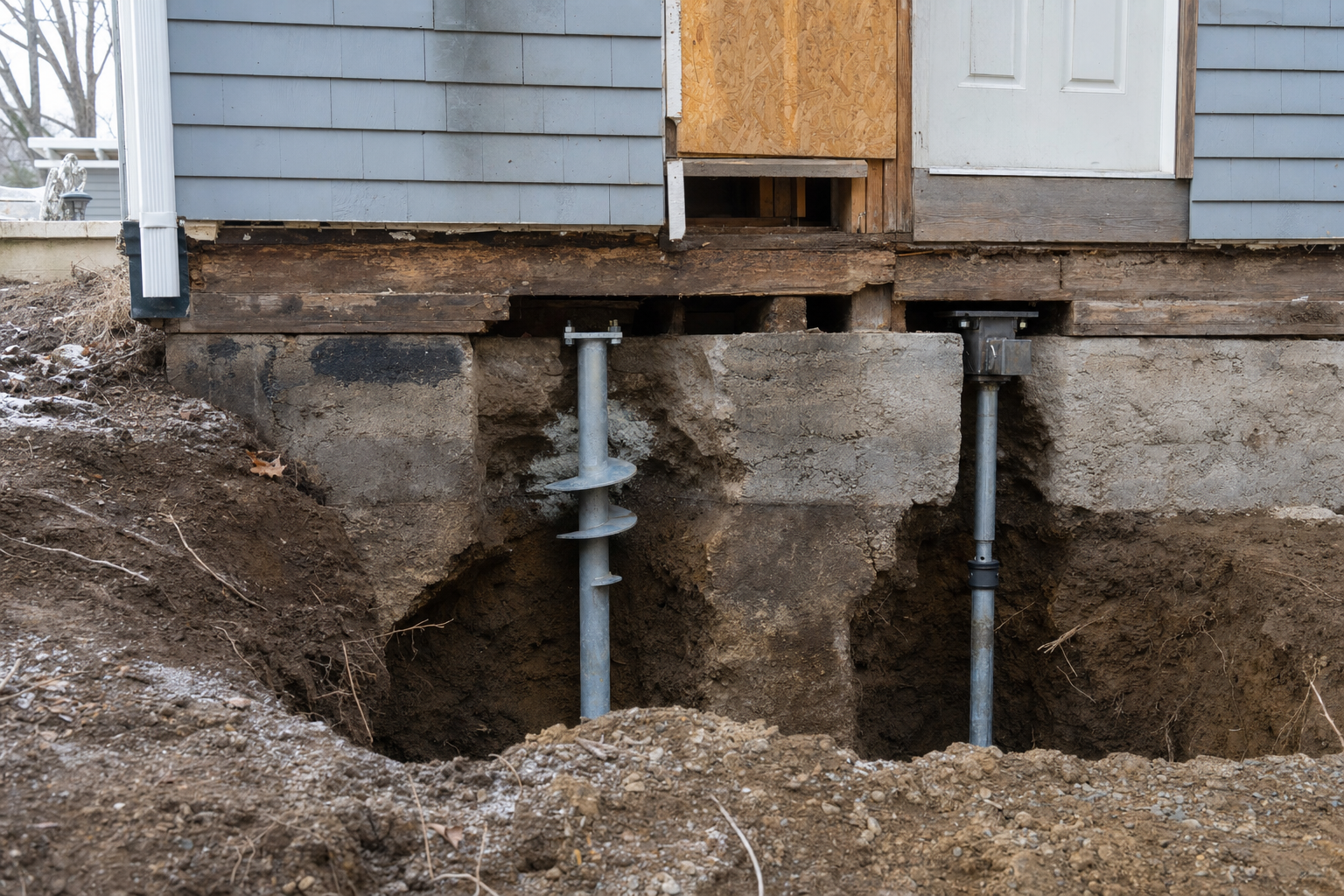
Helical and push piers both stabilize settling foundations. Which one is right depends on your soil profile, your foundation type, and what specifically is settling. There is no universal answer, and any contractor who recommends one without examining the site is selling, not advising.
Here is how to think about the choice.
What each one actually is
Helical piers
A helical pier is a steel shaft with one or more helical (auger-like) plates welded along its length. It is screwed into the ground using hydraulic torque, like a giant screw being driven into soil. The pier reaches load-bearing strata, the helix plates engage the soil, and the pier carries weight through skin friction along the shaft plus bearing pressure on the plates.
Common manufacturers in our market: Grip-Tite, ECP, Ram Jack, Magnum Piering. Shaft diameters typically 2 7/8 inch to 3 1/2 inch for residential work. Helix plate diameters 8 inch to 14 inch depending on load and soil.
Push piers
A push pier is a hollow steel pipe driven straight down using hydraulic pressure, using the weight of the structure as resistance. The pier is driven until it hits refusal (typically bedrock or very dense soil), at which point it transfers load to that bearing layer.
Common manufacturers in our market: Grip-Tite, ECP, Earth Contact Products. Pipe diameters typically 2 7/8 inch to 3 1/2 inch. Driven length variable depending on depth to refusal.
Where each one works best
Helical piers work best when:
- The site has relatively shallow load-bearing soil within 15 to 25 feet of the surface.
- The structure is too light to drive push piers effectively (some additions, porches, or light commercial).
- The soil profile is consistent and predictable.
- The repair is on a newer foundation with adequate footing connection.
- The project is new construction or a planned addition where load is being added.
- Tight access prevents the equipment needed for push piers.
Push piers work best when:
- The site needs to reach deep bedrock for a stable bearing surface.
- The structure is heavy enough to drive the piers (most full residential foundations qualify).
- Soil conditions are variable and unpredictable.
- The existing footing is robust enough to accept the pier bracket.
- The settling is uniform and the goal is to stabilize and potentially lift.
- Bedrock is reachable at a reasonable depth (most of New England qualifies).
Soil profiles in our market
- Fairfield County: Mixed clay over glacial till, bedrock depth varies 10 to 50+ feet. Both pier types work; push piers more common where bedrock is reachable.
- Hartford County: Connecticut River valley sediment, deeper bedrock in valley bottoms, shallower bedrock in West Hartford and Farmington. Push piers in valley sites, helical in shallow-bedrock sites.
- Litchfield County: Rocky glacial till, shallow bedrock in many areas. Helical piers often work better because depth to refusal is short.
- Westchester County: Mixed rocky and clay, variable bedrock depth. Push piers more common in central and southern Westchester; helical in northern areas with shallower bedrock.
- Dutchess County: Hudson Valley clay over glacial deposits, bedrock at variable depth. Site-specific assessment needed.
Cost
In the CT and NY market:
- Helical piers: $1,800 – $3,500 per pier installed.
- Push piers: $1,800 – $3,200 per pier installed.
The costs are roughly comparable. The total project cost depends much more on how many piers are needed (typically 6 to 14 for a residential repair) than on which type is selected. Total projects typically run $11,000 to $48,000.
Three drivers within the range: depth to bearing strata (deeper piers cost more in materials and labor), access conditions (tight basements add labor), and bracket type (interior vs underpinning vs new construction differs).
Timeline of a typical pier project
Day 1: Inspection and engineering review
Site visit, soil assessment, cracking and rotation documentation. For projects with significant settlement, an engineering review is required before pier specification.
Days 2 to 5: Excavation
Small pit excavations next to each pier location, typically 3 by 3 feet down to the bottom of the footing. Spoils kept on site for backfill.
Days 5 to 8: Pier installation
Helical piers are screwed in with a hydraulic torque motor. Push piers are driven with a hydraulic ram against the foundation. Either way, depth and load measurements are documented at each pier.
Days 8 to 10: Bracketing and load transfer
Steel brackets connect the piers to the existing footing. Hydraulic jacks transfer load from the original footing to the pier system. If lifting is part of the scope, the lift happens during this phase.
Days 10 to 12: Backfill and finish
Pits backfilled and compacted. Yard restoration. Walkthrough with the homeowner showing the as-built pier locations and load documentation.
What homeowners often misunderstand
“Piers will lift my house back to level”
Sometimes. Often not all the way. Both pier types can be used in a lifting attempt after stabilization, but the success of the lift depends on how much rotation the structure has experienced, how rigid the foundation is, and how the load is distributed. Lifts of one to two inches are often achievable; lifts of four plus inches require more aggressive approaches and may compromise other structural elements (sheetrock cracks, door frames, plumbing).
Honest contractors tell you up front whether your settlement is correctable or whether stabilization at the current position is the realistic goal.
“Piers fix the cause”
They do not. Piers stabilize the symptom. The underlying cause (poor soil compaction, washout, leaking plumbing, tree root water draw) still needs to be addressed or the new piers will be carrying the same forces that the original footing failed under.
“More piers is always better”
More piers than required adds cost without adding benefit. Engineering specs typically place piers at 5 to 7 foot intervals along the affected footing area. Closer spacing is needed for heavier loads or weaker soils; wider spacing is fine for stronger conditions.
“All pier brands are the same”
They are not. Wall thickness, helix plate diameter, bracket design, and coating type vary by manufacturer. Grip-Tite and ECP are the two we specify most often because of consistent quality and warranty terms.
Common myths
- “Helical is for light loads only.” Modern helical piers carry 50,000+ pounds per pier when properly designed. Adequate for any residential application.
- “Push piers cannot fail.” They can, if driven into insufficient bearing strata. Refusal depth has to be verified during install.
- “Underpinning will destabilize my neighbor.” Properly engineered underpinning has no effect on adjacent properties. Engineering review covers this.
- “I can DIY pier installation.” Pier installation requires hydraulic torque equipment, load measurement, and engineering verification. This is professional-only work.
Diagnosis matters more than pier type
Most foundation settlement repair projects fail not because of the pier type chosen but because the underlying cause was never identified. Before any pier project, a competent contractor will document:
- The pattern of cracking and rotation.
- The history of any plumbing leaks, drainage issues, or significant tree growth or removal near the foundation.
- The soil profile and water table at the site.
- The condition of the existing footing.
- The proximity of trees, retaining walls, and other potential load sources.
- The history of any prior repair work on the home.
Warranty terms
- Workmanship: Lifetime transferable on the installation.
- Manufacturer: 25 years to lifetime depending on manufacturer (Grip-Tite, ECP both offer strong terms).
- Stabilization guarantee: Continued movement after install is covered under workmanship warranty.
The transferable lifetime warranty becomes a documented selling point if you list the home.
FAQs
How do I know if I need piers vs other repair?
Piers address settlement (downward movement). They do not address bowing (lateral movement) or seepage (water management). If your wall is bowing inward, you need carbon fiber or steel beam reinforcement, not piers. If your basement is wet but not settling, you need drainage, not piers.
Will pier work disrupt my landscaping?
Yes, in the excavation footprint at each pier location. Plan on restoring landscaping within 3 feet of each pier pit. Total disruption is much less than full exterior excavation but is not zero.
Are permits required?
Yes for most foundation repair projects in CT and NY. We handle permitting and engineering review where required.
How long does the project take?
Typical 8 to 12 pier project: 8 to 12 working days on site. Larger or more complex projects may run 2 to 3 weeks.
We do this assessment as part of every free inspection. Written estimate within 24 hours, no pressure on the call.
Book your free inspection
No obligation. Written estimate within 24 hours.
Tell us what is happening with your basement and we will email a written estimate within 24 hours. No cost, no obligation, no high-pressure follow-up.
Get my free estimate