
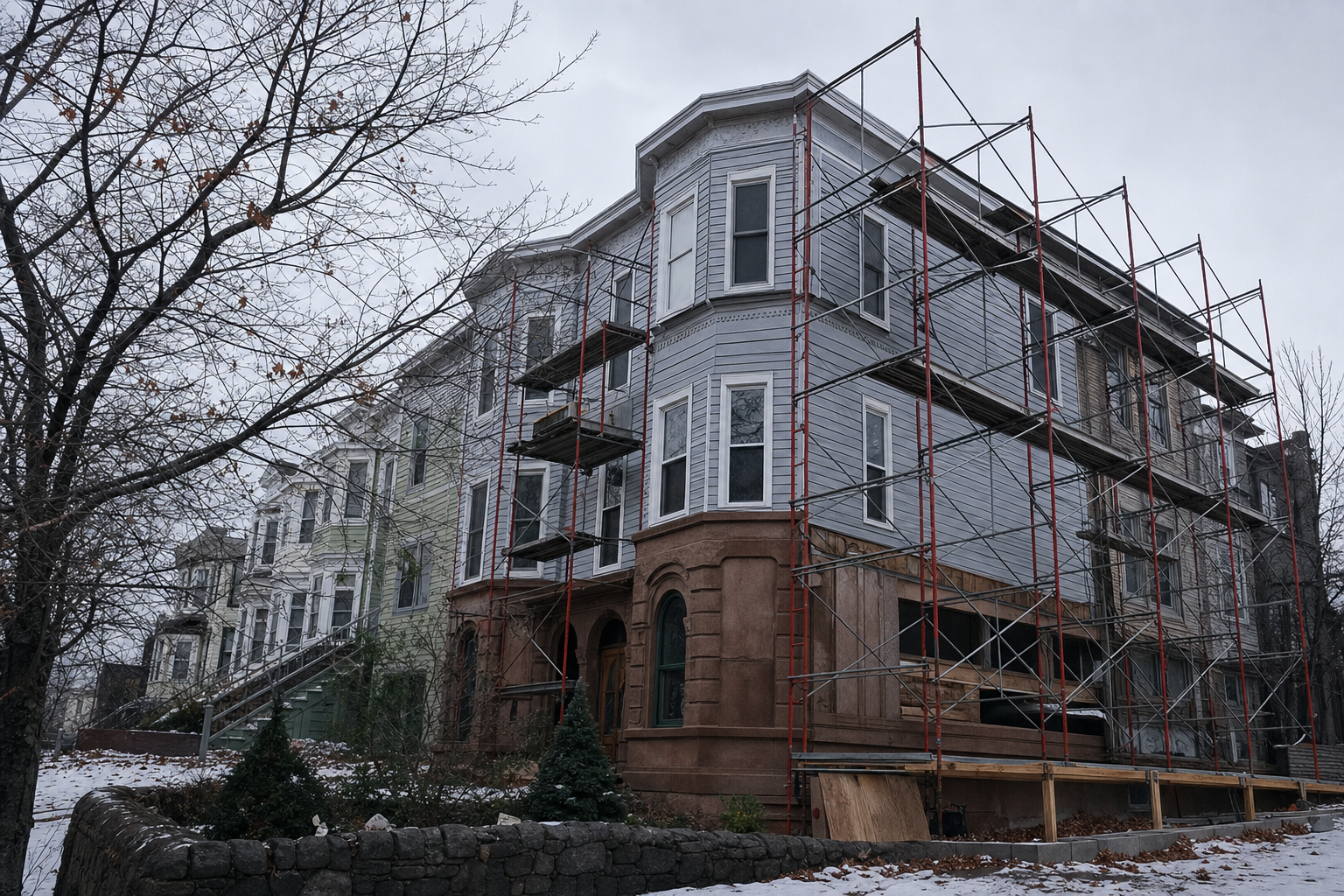
Greenwich has a small but architecturally distinct stock of brownstone-foundation row houses, mostly in the older downtown sections and along the older streets of central Greenwich. These foundations are unlike anything else in the state. The stone itself is sedimentary, much softer than the fieldstone or granite used elsewhere in Connecticut, and the wall construction often relies on the adjoining party walls for lateral support.
If you own one of these homes, here is what makes the foundation work different and what to watch for.
Where brownstone foundations sit in Connecticut history
The Connecticut River valley brownstone quarries (Portland, Cromwell, Middletown) supplied much of New England with building stone from the 1830s through the 1890s. The signature brick-red sedimentary stone was used for high-end residential construction in coastal Fairfield County, particularly Greenwich, Stamford, and parts of Norwalk, between 1860 and 1900. Greenwich’s brownstone-foundation homes are mostly clustered in central Greenwich and along the early downtown streets.
By the early 1900s the quarries closed and new construction moved to granite, brick, and eventually concrete. The brownstone homes that remain are typically 125 to 165 years old, with a foundation material that needs specific handling.
The stone
Brownstone is a soft sandstone, primarily quarried in the Connecticut River valley historically. It weathers differently than granite or fieldstone:
- It absorbs water more readily.
- It spalls (surface flakes break off) under freeze-thaw cycles.
- The cut faces erode over decades, leaving the wall thinner than original spec.
- The bedding mortar between courses fails before the stones themselves do.
- It cannot tolerate Portland cement mortar without progressive face damage.
None of this is alarming on its own. It is the normal aging pattern for a 100 plus year old brownstone wall. The question is always whether the cumulative wear has reached the point where structural intervention is needed.
Party-wall dependencies
Many of these row houses share foundation walls with their neighbors. The lateral stability of one home depends on the stability of the adjoining homes. This affects:
- Excavation: We cannot do exterior excavation on a shared wall without coordinating with the neighboring owner.
- Reinforcement: Carbon fiber or steel beam reinforcement is the typical approach because it is interior-only.
- Drainage: Interior drainage systems can be installed independently of the neighbors.
- Settlement repair: Underpinning a single home in a row house cluster needs engineering review to avoid loading effects on the adjoining structures.
Common issues we see
Mortar joint failure
Brownstone bedding mortar from the original construction era is typically lime-based and softer than modern Portland cement mortar. After a century of moisture cycling, the joints lose cohesion. Water passes through, and small stone fragments can work loose.
The repair approach is to use a compatible lime-based mortar for repointing. Using modern Portland cement on a brownstone wall is a known failure mode because the mortar becomes harder than the stone, and freeze-thaw damage shifts from the mortar (where it belongs) to the stone itself.
Foundation moisture wicking
Brownstone absorbs water through capillary action much more readily than denser stones. A wall that looks dry on the inside can still have significant moisture content in the stone itself. Interior dehumidification and vapor management are particularly important in these homes.
A 20-mil reinforced poly vapor barrier with proper wall fastening is the standard approach. Mechanical fastening at the top of the wall is critical; adhesives alone fail against the porous stone surface within a decade.
Shared sump systems
In some row-house clusters, the original construction included a shared sump or shared drainage. These systems are now often a hundred years old and were never documented. Discovering them during repair work is common.
We document any shared system found during inspection, photograph the routing, and coordinate with neighbors before modifying anything. The default approach is to install an independent system that does not rely on the shared infrastructure, in case the older system fails or is removed by a neighbor’s work.
Spalling and stone face loss
Visible flaking of the stone face is common in 100-year-old brownstone walls and is usually not a structural concern by itself. Spalling is concerning when:
- Multiple inches of original face have been lost from one section.
- The spalling has exposed deteriorated mortar behind the stone.
- The pattern follows a horizontal band consistent with saturated soil contact.
- Spalling is accompanied by sounds during freeze-thaw transitions.
Stabilization options include rebuilding affected sections with compatible salvage stone or consolidating the existing stone with breathable consolidants. Both are specialty work; we coordinate with restoration masons where needed.
Cost ranges for brownstone work
- Interior perimeter drainage in a brownstone basement: $14,000 – $22,000 (higher than standard because of wall surface complexity).
- Lime-based mortar repointing: $4,500 – $9,000 for a typical wall section, more for full perimeter.
- Carbon fiber strap reinforcement on a brownstone wall: $5,500 – $9,000 for a 20-foot wall (higher than block because of surface prep complexity).
- Sump pump with battery backup and independent discharge: $2,800 – $4,500.
- Spalling stabilization with salvage stone: $400 – $1,200 per affected section.
Three drivers: wall surface condition (more deterioration means more prep), shared-wall coordination requirements, and historic-district review where applicable.
What to ask your contractor
- Have you worked on brownstone foundations specifically?
- Will you use lime-based or Portland-based mortar for any repointing?
- Do you have permission documentation for shared-wall work?
- Is the proposed drainage system independent of any neighbor’s drainage?
- How will you handle the spalling areas during prep?
- Is the vapor barrier mechanically fastened or adhered?
- Do you carry insurance for shared-wall work?
Common myths about brownstone foundations
- “Portland cement is stronger so it must be better.” Wrong direction. Portland cement bonds harder than the stone and forces freeze-thaw damage into the stone face. Lime-based mortar is the correct match.
- “All historic stonework looks the same to a mason.” It does not. Brownstone, fieldstone, granite, and limestone all require different mortar and repair techniques. Match the mason to the stone.
- “Sealing the outside will preserve the stone.” Many sealers trap moisture inside the stone, accelerating spalling. Breathable consolidants are the correct approach; impermeable sealers are the wrong approach.
- “My row house’s foundation is the same as my neighbor’s.” Each owner’s foundation work history is different. Documentation matters.
Real-estate transaction considerations
Greenwich brownstone listings increasingly include foundation condition reports as part of pre-listing prep. Buyers and their inspectors flag any brownstone basement that has visible water history or unaddressed mortar deterioration. Pre-listing foundation work pays for itself in higher offers and faster closing; the transferable lifetime workmanship warranty becomes a documented selling point.
FAQs
Do I need a historic district review for interior drainage work?
Typically no. Interior work is not visible from outside the home and does not trigger historic review in most Greenwich jurisdictions. Verify with the local historic district commission if your property is listed.
How long does brownstone repair work take?
Interior drainage: 4 to 6 days (slightly longer than poured concrete because of wall surface prep). Lime-based repointing: 1 to 2 days per wall section. Carbon fiber straps: 1 day plus 24 to 72 hour cure.
Will the work affect the historic value of the home?
Properly executed work using compatible materials preserves historic value. Improperly executed work (Portland cement on brownstone, impermeable sealers, structural alterations to the original wall pattern) reduces historic value and can trigger future repair costs.
Are permits required?
Interior drainage and crack injection typically do not require permits. Repointing or any structural reinforcement may, depending on the specific Greenwich jurisdiction. We handle permitting where required.
Free assessment
Greenwich brownstone work requires specific knowledge that not every contractor has. We have done this work and we will tell you honestly what your home needs. Free inspection, written estimate within 24 hours.
Book your free inspection
No obligation. Written estimate within 24 hours.
Tell us what is happening with your basement and we will email a written estimate within 24 hours. No cost, no obligation, no high-pressure follow-up.
Get my free estimate