
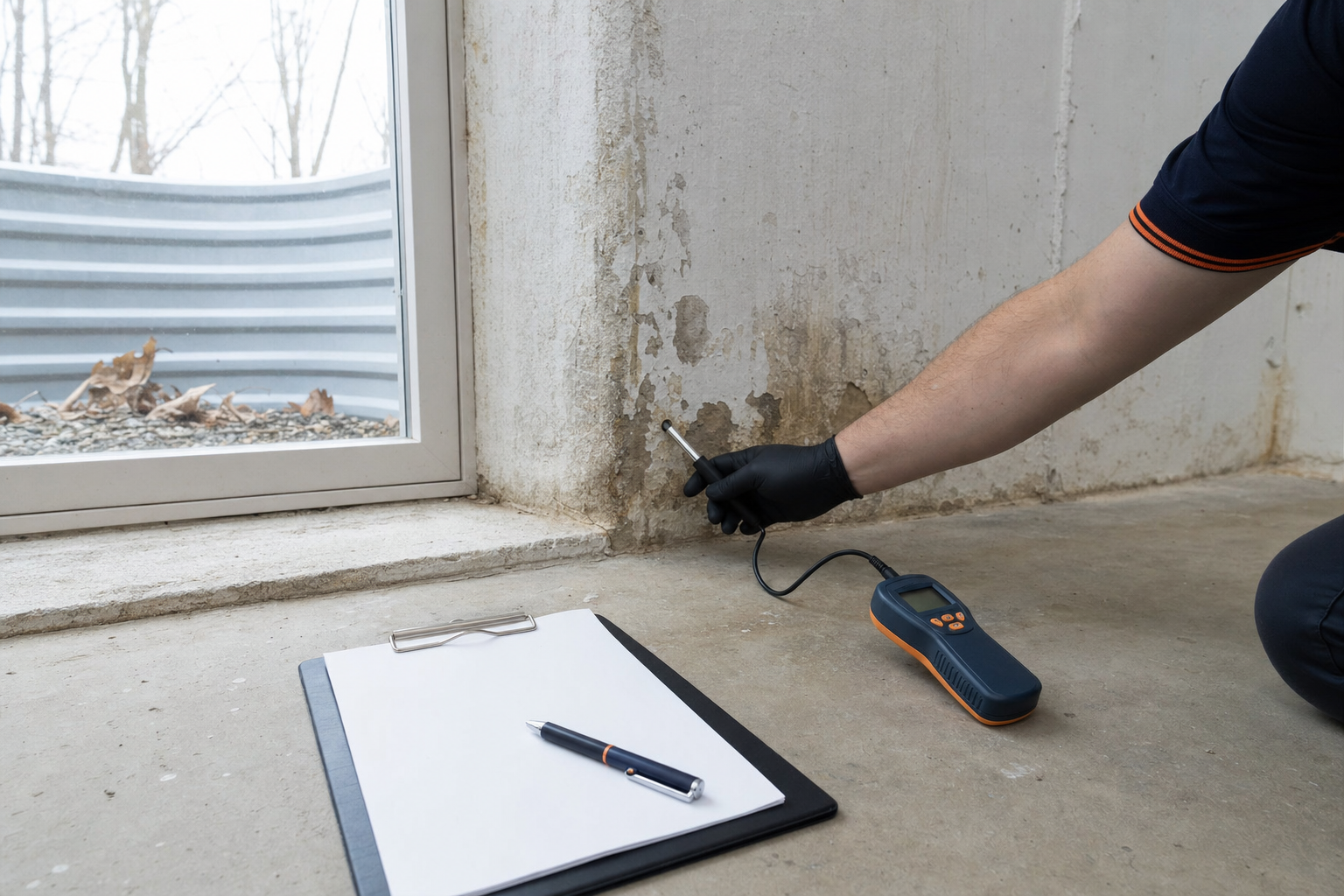
The inspector wrote “moisture present in basement, further evaluation recommended” and now you have five business days to respond. The buyer wants a credit. Your agent wants to know what to say. You want to know whether this is a $400 fix or a $15,000 fix, and whether the deal needs to be renegotiated.
Here are the five steps to take, in order, when a CT or NY home inspector flags basement moisture during a real-estate transaction.
Step 1: Read the inspection report language carefully
Inspectors write in calibrated language for legal exposure. The phrase the inspector chose tells you the severity:
- “Evidence of past moisture intrusion” = something happened, sometime. Could be 1985 or last March.
- “Efflorescence noted” = mineral salts left by evaporated water. Water moved through; frequency unknown.
- “Active seepage observed” = water visible during inspection. Always significant.
- “Moisture meter readings elevated” = quantifiable; usually flagged when readings exceed 18 to 20% on wood or 75% relative humidity in the air.
- “Stained drywall” or “softened wall base” = chronic enough to damage materials.
- “Hydrostatic pressure indicators” = water is pushing on the foundation from outside.
Active seepage and softened materials are higher-risk findings than efflorescence and “evidence of past moisture.” This matters for negotiation.
Step 2: Walk the basement and exterior yourself
Most of what an inspector saw is visible to anyone who knows where to look. Inside, check:
- Bottom 18 inches of every wall for staining, paint blistering, efflorescence.
- The cove joint (where wall meets floor) for mineral staining.
- Wood stair stringers and bottom plates that touch the slab.
- Stored items along walls (cardboard, fabric) for mold or moisture damage.
- Sump pit (if present) for water level history, pump type, discharge line condition.
- Any dehumidifier and its drainage method.
Outside, check:
- Grade away from the foundation: should slope 6 inches over the first 10 feet (about 5% grade).
- Downspout terminations: should discharge at least 5 feet from the foundation, ideally 10.
- Gutter condition: clogged, sagging, or missing sections cause concentrated wall loading.
- Window wells: filled with debris, no covers, or below grade.
- Mulch or hardscape level versus the top of the foundation.
Many inspector “moisture flags” are solvable with $400 of grading and gutter work. Identify those before assuming the worst.
Step 3: Bring in a waterproofing contractor for a written assessment
Most CT and NY waterproofing contractors will inspect inside the buyer’s contingency window at no cost. The contractor’s report is the document your real-estate attorney and lender will use to evaluate the actual severity and cost.
The contractor’s report should tell you:
- Cause of the moisture (grading, gutter, foundation crack, hydrostatic pressure, condensation, plumbing).
- Severity classification (cosmetic, recurring nuisance, recurring damage, structural risk).
- Recommended remediation with scope, materials, and cost.
- Timeline for the work.
- Warranty terms.
Get this in writing within 48 hours of the inspection. The negotiation window is short.
Step 4: Decide whether to repair, credit, or walk
Three negotiation paths exist:
Path A: Seller repairs before close
Best when: the issue is small to moderate, scheduling allows, and the seller wants to preserve the closing timeline. The seller gets warranty paperwork delivered to the buyer at close. Cleanest outcome.
Path B: Closing credit for buyer to repair
Best when: timeline is tight, buyer wants control over scope, or seller cannot stage repair work. Watch out: closing credits sometimes get applied to closing costs rather than the repair. If you negotiate a credit, escrow it with instructions, or document the buyer’s commitment to use it for waterproofing.
Path C: Renegotiate price
Best when: the issue is large enough to materially change the value, or when buyer’s lender requires resolution before close. Price reductions reduce the appraisal anchor; credits leave the price intact but reduce net to the seller.
Step 5: Document everything for the closing folder
- Contractor’s inspection report.
- Scope of work signed by both parties.
- Permit records for any permitted repair.
- Completion invoice and photographs.
- Warranty paperwork (transferable assignment to buyer at close).
- Any engineer’s report if structural review was needed.
Hand this folder to the buyer’s attorney before the final walk-through.
Why basement moisture hits CT and NY homes the way it does
Most CT and NY housing stock falls into one of three vintages, each with characteristic moisture behavior:
- Pre-1945 stone or rubble foundations (Hartford, Yonkers, Poughkeepsie, downtown Norwalk, Greenwich older estates): mortar joints fail over decades. Water moves through stones during wet seasons.
- 1945 to 1990 CMU block (Hartford suburbs, White Plains, Carmel, postwar Fairfield County): hollow cells fill with water; cove joint seepage common.
- Post-1990 poured walls (newer suburbs and developments across CT and NY): cleaner builds but new construction without site drainage planning still seeps at the cove joint.
Frost depth in both states sits around 42″ per CT IRC Chapter 4 and NY R301.2, so footings are deep, which means water can sit against walls for extended periods before grading and drainage steer it away. Clay-belt areas (Hudson Valley, Hartford floodplain, parts of Fairfield) hold water against walls longer than sandy or gravelly substrates do.
Cost ranges by finding type
- Grading and downspout work: $400 to $1,500.
- Crack injection (per crack): $400 to $900.
- Sump pump install or upgrade: $1,400 to $3,200.
- Battery backup sump addition: $700 to $1,500.
- Interior perimeter drainage: $5,500 to $14,000.
- Exterior excavation waterproofing: $12,000 to $40,000.
- Wall anchor system: $7,500 to $18,000.
- Carbon fiber straps (per strap): $550 to $850.
- Mold remediation: $1,500 to $20,000 depending on scope.
Three factors move you within ranges: linear feet of perimeter that needs treatment, accessibility constraints (finished walls, storage, narrow basement access), and whether the slab has to be cut.
Common mistakes during the negotiation window
- Negotiating on the inspector’s verbal summary. Read the written report; pull contractor estimates. The number you anchor on shapes the outcome.
- Accepting the buyer’s contractor estimate without a second opinion. Buyer-sourced estimates often run high; sellers should get their own.
- Letting the negotiation drag past the contingency. Most CT and NY contracts have tight contingency windows. Missing them weakens both sides’ position.
- Using hydraulic cement to patch and re-list quickly. Visible patch work telegraphs “water history” to the next inspector.
- Skipping the permit on a structural or drainage repair. Unpermitted work surfaces in town records and creates a financing condition for the buyer’s lender.
Materials and equipment you want in a documented repair
- Interior perimeter drainage channel (WaterGuard, DMX 1-Step, or equivalent).
- Zoeller M53 or M98 primary sump pump.
- Battery backup pump with maintenance-free battery and audible alarm.
- 20-mil reinforced vapor barrier on slab.
- Aprilaire 1850F or SantaFe Advance100 whole-basement dehumidifier with hard-piped condensate.
- Polyurethane (not epoxy alone) crack injection for cracks that may need to accommodate slight future movement.
- Grip-Tite or ECP carbon fiber straps for bowing block walls.
Timeline of a typical contingency-window response
- Day 1: Inspection report received.
- Day 2: Contractor walk-through scheduled.
- Day 3 to 4: Contractor inspection performed; written estimate delivered.
- Day 5: Engineer review if needed (typically 2-day turnaround).
- Day 5 to 7: Negotiation finalized; repair scope or credit agreed in writing.
- Week 2 to 4: If repair before close, work performed and warranty documented.
- Closing day: Warranty assigned to buyer with paperwork in the closing folder.
When to call a professional versus DIY
DIY is appropriate for: exterior grading correction, gutter cleaning, downspout extensions, window well covers, removal of stored items, light parging touch-ups on cosmetic spalls. These often improve the inspector’s read of the basement before re-inspection.
DIY is not appropriate for: crack injection, interior drainage installation, sump pump replacement on a critical system, mold remediation beyond 10 sq ft, or any structural repair. The Connecticut HIC license and New York contractor license requirements apply to most of this work, and unpermitted DIY repairs surface as financing conditions during the buyer’s lender review.
Frequently asked questions
Can the buyer terminate the deal over moisture?
Yes, typically, if the issue is “material” under the contract’s inspection contingency language. Materiality is a function of cost and disclosure. A $500 grading fix is rarely material; a $20,000 structural repair is.
How much should I credit the buyer if I do not want to do the work myself?
Use a written contractor estimate as the anchor. Credits at or slightly above the contractor’s estimate usually settle without further negotiation. Credits well above estimate signal panic and invite counter-bids.
Will the lender accept a credit instead of completed repair?
Sometimes. Conventional loans usually yes; FHA and VA often no, particularly when the inspector noted “active” issues. The buyer’s loan officer is the source of truth here.
What if I do not have time to fix it before close?
Escrow the funds in your real-estate attorney’s account with a written scope. The work happens after close; the buyer authorizes release of funds when complete.
Should I disclose old moisture issues that I already repaired?
Yes. Both CT and NY require disclosure of known water issues. Disclosed repairs with paperwork build trust; concealed repairs create post-close legal exposure.
Where to go next
Related reading: buyer’s basement checklist, foundation repair before listing, interior versus exterior waterproofing, and our waterproofing service overview.
We do contingency-window inspections for buyers and sellers across CT and NY. Written estimate within 24 hours. The report is yours to use in negotiation, with or without us doing the work.
Book your free inspection
No obligation. Written estimate within 24 hours.
Tell us what is happening with your basement and we will email a written estimate within 24 hours. No cost, no obligation, no high-pressure follow-up.
Get my free estimate