
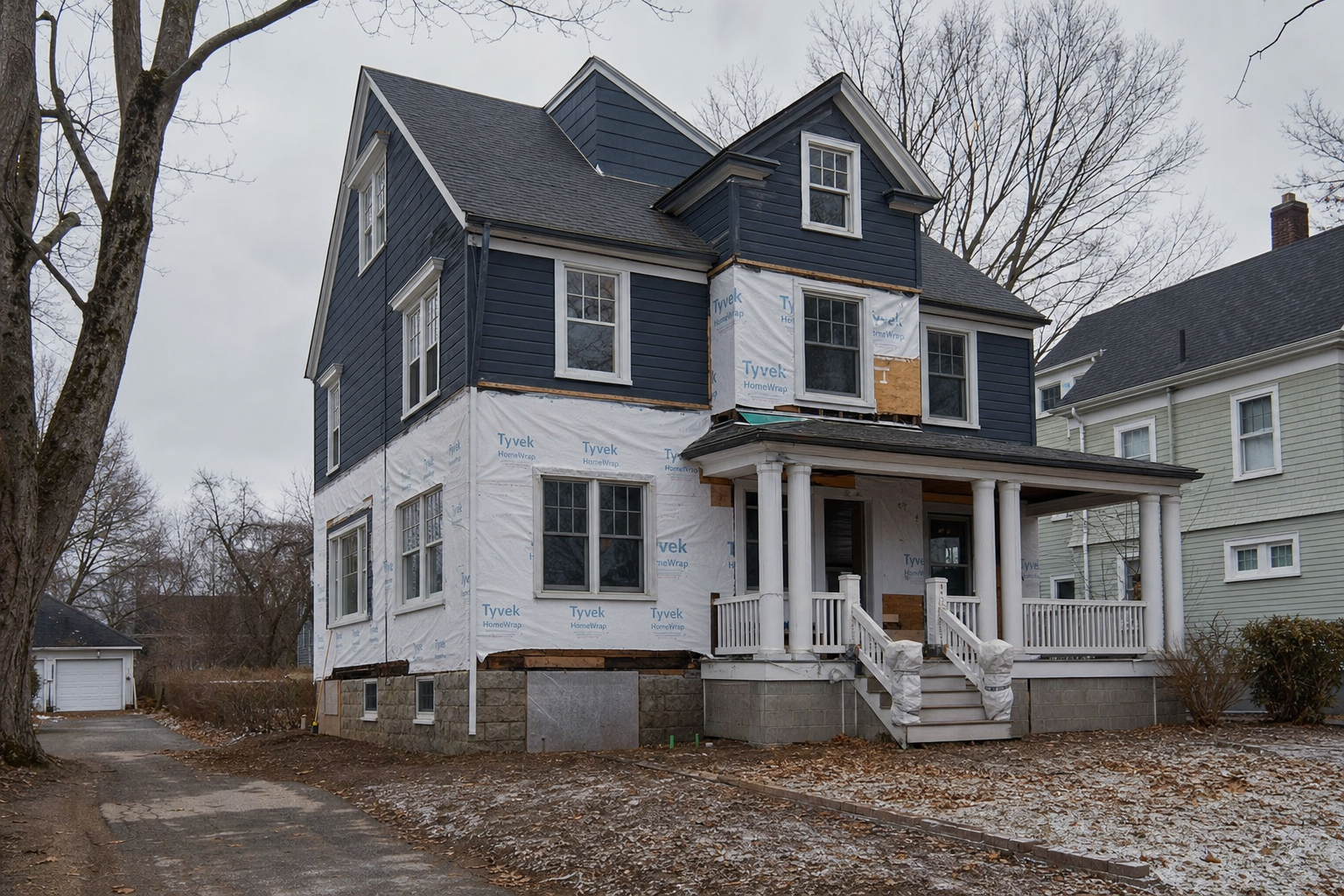
Hartford basements are not like Stamford basements. The soil is different, the housing stock is different, and the water table behaves differently across the seasons. Generic basement waterproofing advice misses the specifics that actually matter when you are deciding what to do about a wet wall in a 1920s Hartford colonial.
Here is what makes the Hartford market specific.
The Hartford geography in one paragraph
Hartford sits at the bottom of the Connecticut River valley. The river runs north-south through the city and floods on a roughly 20-year recurrence interval. The west side of the city rises into West Hartford and Farmington with glacial till and exposed bedrock pockets. The east side flattens into East Hartford and Manchester with alluvial deposits. The river itself drives the seasonal water table behavior of every basement within a 5-mile radius of downtown.
The housing stock
Most of Hartford’s residential foundation work happens in homes built between 1900 and 1965. The dominant foundation types are:
- Pre-1945 fieldstone or rubble stone foundations. Common in the West End, Asylum Hill, and Frog Hollow neighborhoods. These walls were built mortared but the mortar joints have deteriorated. Water passes through the joints during heavy events. Interior drainage with a sealed dimpled membrane is usually the right solution.
- 1945 to 1965 concrete block (CMU) foundations. Common across most of the postwar Hartford suburbs. Hollow cells fill with water from below. The right solution depends on whether the cells are dry or hydrostatically loaded.
- Poured concrete foundations (post-1965). Less common in the city proper, more common in the surrounding towns. Generally drier walls; problems are usually at the cove joint or at form ties.
The soil
Hartford’s soil profile is dominated by the Connecticut River valley sediment, which means clay-heavy fill over gravelly subsoil in many areas. Clay holds water against foundations during wet seasons and shrinks away from foundations during dry summers. Both directions of movement contribute to lateral pressure on basement walls over time.
West of the river, in areas like West Hartford and Farmington, the soil is more variable, with more glacial till and exposed bedrock pockets. East of the river, in Manchester and East Hartford, the alluvial deposits create different drainage patterns.
The water table
The Hartford area has a relatively shallow seasonal water table, with significant fluctuations between dry summers and wet springs. A homeowner who sees no basement seepage in August can have active wall seepage in April. This seasonality affects how we recommend waterproofing solutions: interior drainage with a sump pump handles the seasonal surge in a way that exterior excavation alone often cannot.
The 1955 flood (Connecticut River) is still the benchmark event in flood-zone planning across the region. Basements within the FEMA 100-year floodplain face different design requirements than those outside it. We pull the floodplain status on every inspection so the homeowner knows what they are working with.
Common problems by neighborhood
- West End and Asylum Hill: Fieldstone foundation seepage, particularly at floor-to-wall joints. Many of these homes are turn-of-the-century with rubble stone foundations that pass water through the mortar joints. Interior drainage with a vapor barrier is the standard fix.
- South End: Block foundation bowing from clay pressure, hairline cracks from settlement. Carbon fiber straps handle most of the bowing cases here.
- North End: Mix of older block and newer poured walls; cove joint seepage is the most common single complaint.
- West Hartford: Sump pump failures during peak spring flow; older homes with undersized drainage systems. Mid-century Cape and Colonial housing stock with 1950s sump pumps that were never sized for current rainfall patterns.
- Bloomfield and Windsor: High water table seepage in basements that were finished without drainage planning. Many of these homes were finished in the 1980s and 1990s without addressing the underlying water issue.
- Farmington and Avon: Glacial till with seasonal saturation; intermittent seepage during heavy events; some bedrock-bound foundations with unique drainage challenges.
- East Hartford and Manchester: Alluvial soil with shallow water table; near-river properties may need backflow preventers on discharge lines.
Hartford-specific cost ranges
- Interior perimeter drainage (1,400 sq ft): $9,000 – $14,000.
- Sump pump replacement with battery backup: $1,800 – $3,200.
- Carbon fiber strap reinforcement (20-foot wall): $4,500 – $7,500.
- Crack injection (single non-structural crack): $400 – $900.
- Fieldstone foundation repointing with interior drainage: $11,000 – $18,000 for full perimeter.
- Crawl space encapsulation (1,200 sq ft): $8,000 – $15,000.
Hartford pricing tends to run slightly below Fairfield County pricing for the same scope because labor and access are more straightforward in most Hartford neighborhoods.
What Hartford homeowners often misdiagnose
- Seepage assumed to be from the roof. If your basement is wet during a heavy rain, your first instinct is to blame the gutters. Sometimes correct, often not. Cove joint seepage looks identical and has nothing to do with the roof.
- “It only happens during heavy rain.” This is true for most cove joint seepage. It does not mean it is not a problem. Cumulative damage over years adds up.
- “My fieldstone wall has been damp forever, it must be fine.” Damp is not fine. It is the precondition for mold, insulation degradation, and progressive mortar deterioration.
- “Exterior excavation is the only real fix.” In Hartford soil profile, interior drainage solves the same problem at 30 to 40% of the cost.
What we recommend
Any Hartford-area home that has had basement seepage in two of the last three springs warrants a real assessment. The cost difference between fixing it now versus fixing it after another five years of progressive damage is typically two to four times.
We do free inspections across Hartford County and the immediate suburbs. Written estimate within 24 hours, no pressure to sign on the visit.
Real-estate transactions in the Hartford market
Hartford-market buyer’s inspectors are increasingly flagging basement moisture issues, fieldstone foundation seepage, and unencapsulated crawl spaces as material defects requiring negotiation. Pre-listing repair almost always pays better than post-inspection negotiation, and a transferable lifetime warranty becomes a documented selling point that survives the closing.
FAQs
My Hartford basement smells musty but I do not see water. Is that a problem?
Almost always yes. A musty smell means moisture is present, which means mold spores are establishing somewhere. The water may be wicking through the wall without forming visible droplets. A moisture meter check at the wall takes 5 minutes during an inspection and gives you the answer.
Is my Hartford home in a flood zone?
You can check FEMA’s flood map service free online. Properties in the 100-year floodplain (Zone A or AE) may need flood vents, elevated mechanicals, and backflow preventers on discharge. We can advise on what your specific zone requires.
Are permits required for basement waterproofing in Hartford?
Interior drainage typically does not require permits. Exterior excavation and structural foundation repair do. We handle permitting where required.
How long does the work take?
Interior drainage on a typical 1,400 sq ft Hartford basement: 3 to 5 days. Sump pump replacement only: 1 day. Carbon fiber strap install: 1 day plus cure time.
Service areas in the Hartford market
We work across Hartford, West Hartford, East Hartford, Manchester, Bloomfield, Windsor, Farmington, Avon, Newington, Wethersfield, and the surrounding towns. The crew is based in Connecticut; response time on inspection appointments is typically 3 to 7 business days during peak season, 1 to 3 days off-peak.
Book your free inspection
No obligation. Written estimate within 24 hours.
Tell us what is happening with your basement and we will email a written estimate within 24 hours. No cost, no obligation, no high-pressure follow-up.
Get my free estimate