
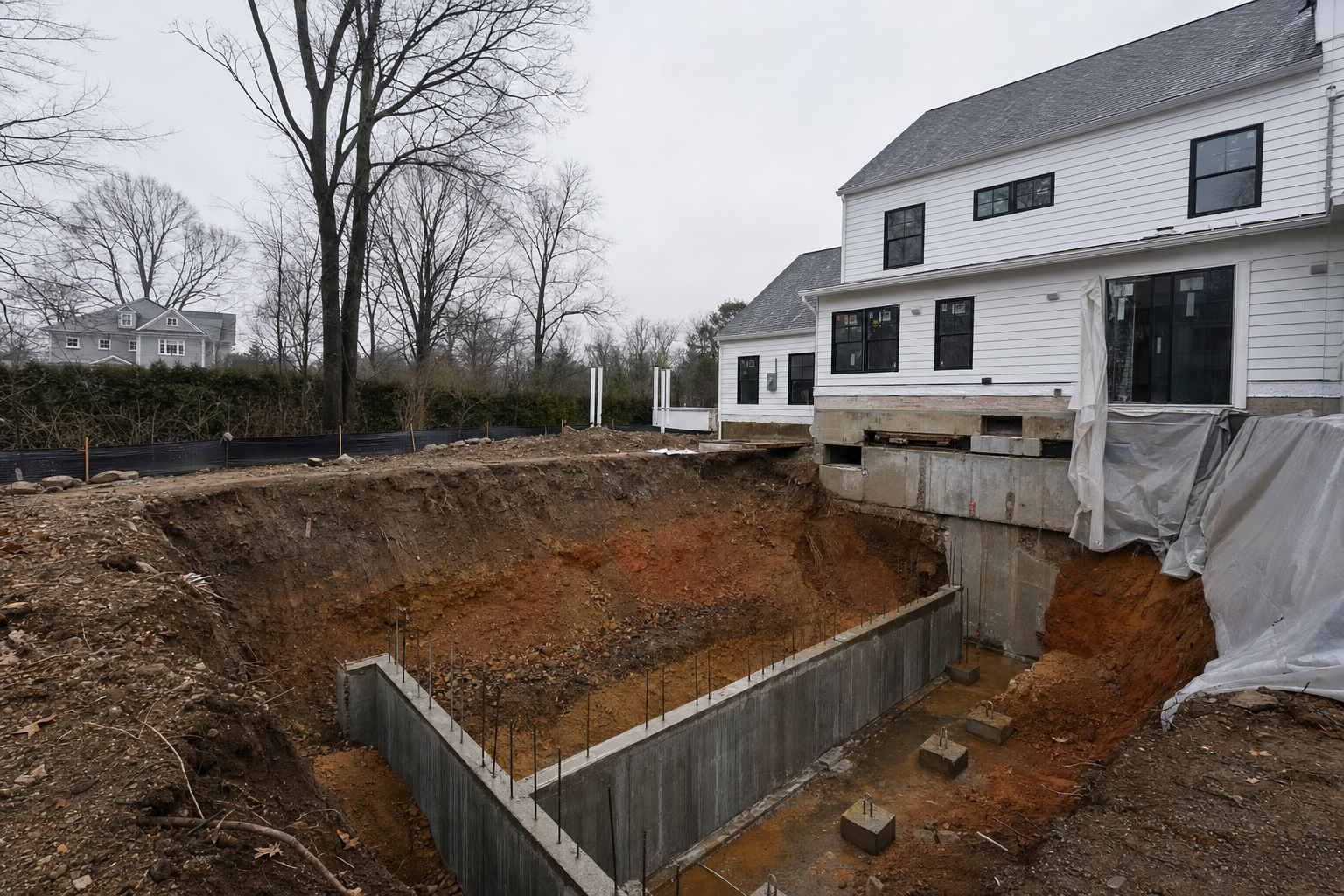
Fairfield County’s clay-heavy soil creates a specific set of basement problems that homeowners often misdiagnose as foundation failure when they are really soil mechanics issues. Understanding what the clay is actually doing makes the right repair approach much clearer.
The Fairfield County soil profile in one paragraph
Fairfield County’s soil is dominated by glacial deposits from the last Ice Age, with coastal sand belts along Long Island Sound (Norwalk, Westport, parts of Stamford), clay-heavy fill in the central county (Stamford, Greenwich, Darien), and increasingly rocky till as you move north toward Danbury, New Canaan, and Ridgefield. Clay-heavy zones are where most of the seasonal basement problems concentrate. The Connecticut State Building Code references the CT IRC, which sets footing depth at 42 inches for our climate zone.
What clay soil does that sandier soil does not
Clay holds water. Sandy soil drains water. That single difference produces several downstream effects on basement walls:
1. Swelling and shrinking
Clay expands when wet and contracts when dry. The volume change is significant: clay-heavy soil can swell 10 to 15% during wet seasons and shrink the same amount during dry summers. Foundation walls experience this as cyclic pressure: pushed inward during the wet season, then released during the dry season, then pushed again the following year.
Over decades, this cycling fatigues block walls and contributes to horizontal cracking and bowing.
2. Slow drainage during heavy events
When a major rain event saturates clay-heavy soil, the water does not drain away quickly. It sits in the soil column against the foundation for days or weeks after the storm has passed. This sustained contact gives water time to find every pathway through the wall.
This is why Fairfield County homes often see basement seepage that lasts longer than a single storm event, while homes in sandier soil areas see seepage that drains within hours.
3. Hydrostatic pressure under the slab
The clay layer typically extends under the basement slab as well. When the soil is saturated, water pressure builds up underneath the slab and pushes water up through any cracks or at the cove joint. This is the most common single source of cove joint seepage in Fairfield County homes.
4. Frost heave amplification
Clay holds water in pore spaces, and that water expands roughly 9% when it freezes. Clay-heavy soil produces more frost heave per cubic foot than sandy soil. Footings sitting in clay below the 42-inch frost line are generally protected, but utility trenches, driveway slabs, and exterior steps in clay zones are vulnerable.
Typical Fairfield County seepage timeline through a year
- March to May: Peak season. Snowmelt plus spring rain plus saturated clay produces multi-day seepage events.
- June to August: Hot and dry. Clay shrinks away from foundation, less wall pressure, less seepage. Summer humidity becomes the dominant moisture issue.
- September to November: Fall rain refills the soil column. Seepage events tied to specific storms.
- December to February: Freeze-thaw cycles drive crack-widening and frost heave on shallow exterior features.
What to do about it
Surface drainage first
The lowest-cost meaningful improvement is correcting surface drainage so less water reaches the soil column next to the foundation in the first place:
- Downspouts discharging at least four feet from the foundation.
- Grading sloped away from the house for the first six feet of perimeter.
- French drains in low spots where surface water collects.
- Yard regrading where settling has reversed the original slope.
These will not solve a serious water problem but they will reduce the load on whatever interior systems you have.
Interior drainage for active seepage
If the basement is already wet, interior perimeter drainage with a properly sized sump pump is the standard Fairfield County solution. Exterior excavation in clay soil is expensive, slow, and disruptive because the clay does not stack well during excavation and the backfill compaction takes longer.
Standard spec in our market: 4-inch perforated PVC pipe in clean 3/4-inch crushed stone, 20-mil reinforced poly vapor barrier on the wall, Zoeller cast-iron pump with battery backup, 18-inch minimum basin.
Wall reinforcement for bowing
For walls already showing inward bow from clay pressure, carbon fiber straps or steel beam reinforcement stop further movement. Neither system pushes the wall back, but both stop the progression.
Carbon fiber works for bowing under 2 inches; steel beams handle 2 to 4 inches; over 4 inches usually means exterior excavation and partial replacement.
Fairfield County cost ranges
- Surface drainage corrections (downspouts, grading, French drains): $800 – $4,500.
- Interior perimeter drainage (1,400 sq ft): $10,000 – $15,000.
- Sump pump with battery backup: $2,200 – $3,800 installed.
- Carbon fiber strap reinforcement (20-foot wall): $4,500 – $7,500.
- Steel beam bracing (per wall): $9,000 – $16,000.
- Exterior waterproofing (full perimeter): $25,000 – $50,000+ depending on excavation depth and landscape restoration.
Fairfield County tends to run on the upper end of CT pricing because of higher labor rates and tight access on many lots.
Common myths in the Fairfield clay-soil context
- “Sealing the inside of the wall will stop the water.” Hydrostatic pressure from saturated clay will push interior coatings off the wall within seasons.
- “Exterior excavation is the gold standard.” In clay soil with tight access, interior drainage solves the same problem at 30 to 40% of the cost.
- “My house has been here for 80 years, the wall must be fine.” Clay-driven bowing accelerates after the first inch. The wall stayed within tolerance for decades before crossing a threshold; the threshold matters.
- “Bigger sump pump fixes everything.” A bigger pump with no drainage system to deliver water to the basin is just a bigger pump sitting dry.
Real-estate angle in Fairfield
Stamford, Greenwich, Norwalk, and Westport listings increasingly include foundation condition reports as pre-listing prep. Buyer’s inspectors flag any signs of past or current basement water issues, and the resulting negotiation typically reduces the listing price by two to three times the actual repair cost. Pre-listing repair pays for itself in higher offers and faster closings.
When to call a pro vs DIY
DIY-appropriate work in clay-soil context: downspout extensions, grading correction with clean fill, regular bucket-testing the sump pump, photographing cracks for monitoring.
Pro-only: any horizontal crack, any bowing of more than an inch, interior drainage installation, sump pump replacement, French drains within 6 feet of the foundation, anything involving the wall structure itself.
FAQs
How do I know if I have clay-heavy soil?
Squeeze test: take a damp handful of soil from 6 inches deep next to the foundation. If it forms a ribbon when squeezed between thumb and forefinger and holds shape for more than an inch, it is clay-heavy. If it falls apart immediately, it is sandy.
Will French drains alone solve a clay-soil basement problem?
Sometimes for minor surface water issues. Usually not for active basement seepage, because the water is reaching the foundation through subsurface saturation, not just surface flow. French drains are part of a system, not a standalone solution.
Is the warranty transferable?
Yes. Lifetime transferable workmanship on interior drainage and carbon fiber. Manufacturer warranty on the pump (3 to 5 years for Zoeller, transferable).
How long does the work take?
Interior drainage on a typical 1,400 sq ft basement: 3 to 5 days. Add a day if mold remediation is needed during the work.
What we tell homeowners
If you are seeing intermittent basement seepage in a Fairfield County home and the contractor is recommending exterior excavation as the only option, get a second opinion. Most of the time, interior solutions are equally effective at a fraction of the cost and disruption.
We do free inspections across Fairfield County. Written estimate within 24 hours.
Book your free inspection
No obligation. Written estimate within 24 hours.
Tell us what is happening with your basement and we will email a written estimate within 24 hours. No cost, no obligation, no high-pressure follow-up.
Get my free estimate