
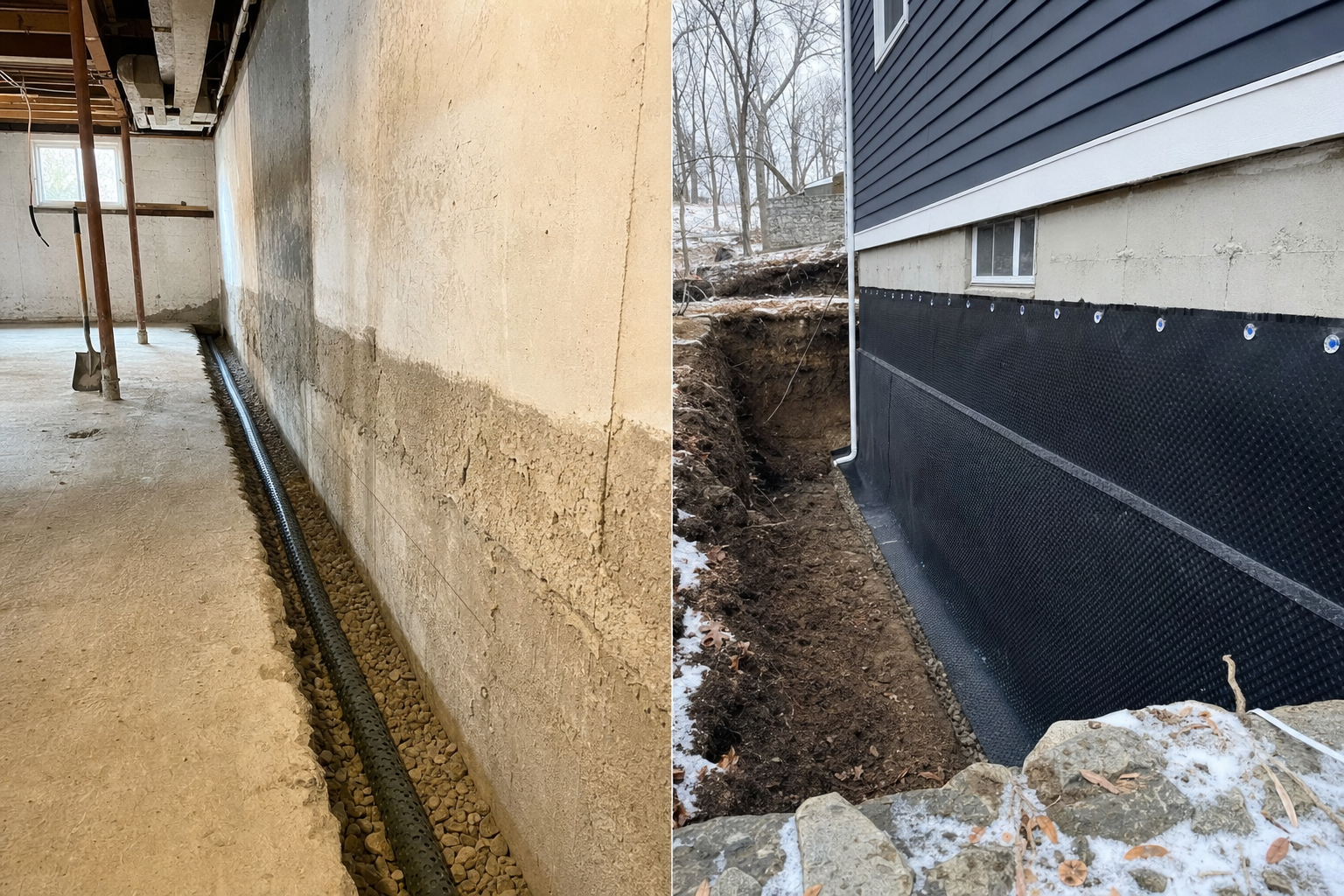
Interior or exterior waterproofing? Both work. Both have legitimate use cases. The contractor pitch you get often depends more on which one the contractor wants to sell than which one is right for your specific basement. Here is the honest side-by-side comparison.
What each one actually does
Interior waterproofing
Interior systems do not stop water from reaching the foundation wall. They manage the water once it gets there. The components:
- A trench cut along the inside perimeter of the basement.
- Drainage pipe in gravel at the bottom of the trench.
- A dimpled vapor barrier on the wall, hanging down into the trench.
- A sump pump and basin that collects the water and discharges it outside.
- New concrete poured to restore the slab.
Water that gets through the wall is intercepted, channeled to the sump, and pumped out. The wall itself can stay damp; the basement stays dry.
Exterior waterproofing
Exterior systems stop water from reaching the foundation wall in the first place. The components:
- Excavation around the outside perimeter, down to the footing.
- Surface preparation of the exterior wall (cleaning, crack repair).
- A waterproof membrane applied directly to the wall.
- A drainage board against the membrane.
- A perforated drainage pipe at the footing level (footing drain).
- Backfill with the surface graded away from the home.
Water is kept off the wall entirely. The wall stays dry on the outside.
Cost comparison
For a typical 1,400 square foot CT basement with full perimeter treatment:
- Interior: $9,000 – $14,000 including sump pump.
- Exterior: $20,000 – $45,000 depending on excavation depth, access, and how much landscaping has to be restored.
Exterior is two to four times the cost of interior for the same square footage. That delta does not include landscaping restoration (often $3,000 to $10,000 separately) or the cost of working around mature trees, driveways, or hardscaping.
Disruption comparison
Interior
- 3 to 5 days total project time.
- Loud and dusty for the first day (concrete saw).
- Basement contents have to be moved.
- Living above the basement is workable throughout the project.
- No yard disruption.
Exterior
- 1 to 3 weeks total project time depending on access.
- Heavy equipment on the property.
- Landscaping torn up around the affected walls.
- Yard restoration after the work is complete.
- Trees within excavation distance may need to be removed.
- Mud and debris through the property.
- Possible disruption to driveways, walkways, and hardscaping.
Performance comparison
Both systems handle the volume of water typical Connecticut and New York basements produce. The question is what they handle differently:
- Interior keeps the basement dry but allows the wall itself to stay damp. For structural concerns where wall moisture matters (mold-sensitive finishes, archival storage), this can be a downside.
- Exterior keeps the wall itself dry. For high-value finished basements, archival storage, or mold-sensitive occupants, the dry-wall benefit can justify the cost premium.
- Interior depends on pump operation. A failed pump during a heavy event means standing water on the floor.
- Exterior works passively. There is no pump to fail (though most exterior installs still include a sump as a secondary system).
Lifespan comparison
- Interior drainage: 30 to 50+ years on the drainage system itself. Pumps replaced every 7 to 10 years. Concrete patches last decades.
- Exterior membrane: 30 to 50 years for high-quality systems (rubberized asphalt, polymeric). Lower-grade dampproofing fails in 10 to 15 years.
Both can carry lifetime transferable workmanship warranties when properly installed.
When interior is the right call
- Existing basement seepage at the cove joint or through wall hairlines.
- Basement that you want dry for storage, finished space, or peace of mind.
- Property where exterior access is constrained (close to neighbors, mature landscaping, hardscaping).
- Project priorities that favor solving the symptom durably without overspending.
- Row houses, townhomes, or zero-lot-line properties.
- Historic district properties where exterior excavation triggers review.
When exterior is the right call
- Wall is structurally failing and needs reinforcement or replacement alongside waterproofing.
- Basement is being converted to high-value finished living space and you want belt-and-suspenders protection.
- Foundation wall has severe cracking that needs exterior access for proper repair.
- New construction or major renovation where the excavation is happening anyway.
- Hydrostatic pressure issues that interior drainage alone has not solved.
- The wall material itself is degrading (severe brownstone spalling, hollow tile failure) and outside protection is needed to slow it.
Common myths
- “Exterior is always better.” For most CT and NY homes, interior solves the same problem at one-third the cost. Better depends on the specific situation.
- “Interior is a band-aid fix.” Properly installed interior drainage with a lifetime transferable warranty is a durable solution, not a temporary one.
- “Exterior prevents future cracks.” Exterior membrane keeps water off the wall. It does not stop soil pressure from causing wall cracks. Bowing walls still bow.
- “I can decide later.” Each year of continued seepage adds to wall material decay, mold establishment, and finish damage. Waiting is expensive.
- “Exterior dampproofing and exterior waterproofing are the same.” They are not. Dampproofing is a thin asphalt coating typical of low-cost exterior work. Waterproofing is a thick rubberized membrane with drainage board. Verify the spec.
Materials comparison
Interior system
- 4-inch perforated PVC pipe, filter fabric wrap.
- 3/4-inch clean crushed stone.
- 20-mil reinforced poly vapor barrier, mechanically fastened.
- Zoeller cast-iron sump pump with battery backup.
- 18 or 24-inch sump basin.
- High-early-strength concrete patch.
Exterior system
- Rubberized asphalt or polymeric waterproofing membrane (60-mil minimum).
- Dimpled drainage board against the membrane.
- 4-inch perforated footing drain in clean stone.
- Filter fabric to prevent silt clogging.
- Compacted clean backfill (avoid clay backfill).
- Surface grading at 1 inch per foot for 6 feet of perimeter.
Timeline comparison
- Interior: Day 1 trench cut, Day 2 drainage install, Day 3 vapor barrier and slab patch, Day 4 sump pump finish and walkthrough.
- Exterior: Days 1 to 4 excavation. Days 5 to 7 wall prep and membrane application. Days 8 to 10 drainage board and footing drain. Days 11 to 14 backfill and grading. Days 15 to 21 landscape restoration.
Real-estate transaction considerations
Either system with a transferable lifetime workmanship warranty becomes a documented selling point. Buyers see “waterproofed basement, transferable warranty, paid in full” as a positive on the listing. The cost difference between interior and exterior is rarely reflected in resale value, which is one more reason interior is the right call for most CT and NY homes.
FAQs
Can I do interior now and exterior later?
Yes, though it is unusual to layer them. Interior drainage typically solves the problem completely; adding exterior later is redundant. The reverse (exterior first, interior later if exterior is insufficient) is more common.
Will exterior work damage my landscaping?
Yes. Plan on full removal and replanting of any landscaping within the excavation footprint. Mature trees within 6 feet of the foundation may need to be removed.
Are permits required?
Interior typically not. Exterior usually yes, including excavation permits and grading approvals depending on local jurisdiction. We handle permitting where required.
Which has the better warranty?
Both can carry lifetime transferable workmanship warranties. Material warranties are similar (25 to 50 years). The warranty is only as good as the contractor still being in business, so confirm both.
What we recommend most often
For most CT and NY homes with active basement seepage and no structural wall failure, interior waterproofing is the right answer. It costs less, disrupts less, and solves the actual problem (water in the basement) just as effectively as exterior work.
We do exterior work when it is the right call. We tell homeowners honestly when it is not. Free inspection, written estimate within 24 hours.
Book your free inspection
No obligation. Written estimate within 24 hours.
Tell us what is happening with your basement and we will email a written estimate within 24 hours. No cost, no obligation, no high-pressure follow-up.
Get my free estimate